
Every session, your agents start from zero
Enterprise Context Management Platform (ECMP) gives every AI agent your company’s agreed definitions and shows it where the data lives.
How it works
AI agents and chatbots don't know your company.
What it does, what its terms mean, where to find its data: someone has to tell them, either people typing it into every chat or teams building it into each agent. Once it's built in, it never gets updated.
ECMP keeps that knowledge in one place, with each item having a named owner. When an agent connects, it receives the current version of what it needs.
Book your discovery call
Thanks for submitting the form!
See how ECMP could work for you
A short call about your agents and the company knowledge behind them.
We'll show you ECMP as it works today, hear how your agents and chatbots get their knowledge now, and think through what ECMP would look like for you.
In the call, we'll:
1.
Show you how ECMP works today
2.
Understand where you are now
3.
Shape it around your needs
Stop managing company knowledge agent by agent
ECMP keeps it in one place, so every agent starts from the same agreed definitions, KPIs and sources.
See what goes wrong when every agent holds its own copy:
Without ECMP
With ECMP
Nobody knows who is responsible for a definition, so nobody fixes it.
Every item has a named owner.
Two agents give two different answers to the same question.
Every agent works from the same definition.
Change a KPI and someone must update every prompt. Miss one, and an agent keeps the old rule.
Change it once. Every agent picks it up.
It knows the term, but not which dataset or report is the real one.
Items tell the agent where the real data lives.
Show agents where the data lives
Your agents learn not just what a term means, but where its data is.
Register each dataset and report once, with its link, whether it sits on a SharePoint site, in a Databricks lakehouse, in Power BI or behind an API. When an agent needs the numbers, ECMP points it to the right place, and it signs in there with the user’s own account.
- Register datasets and reports once, with their real links
- Say what each one holds, how often it updates and who owns it
- Links only to sites your admins trust
- Your data stays where it is: ECMP never copies it or holds the keys
ECMP agent profiles
Not every agent should get everything.
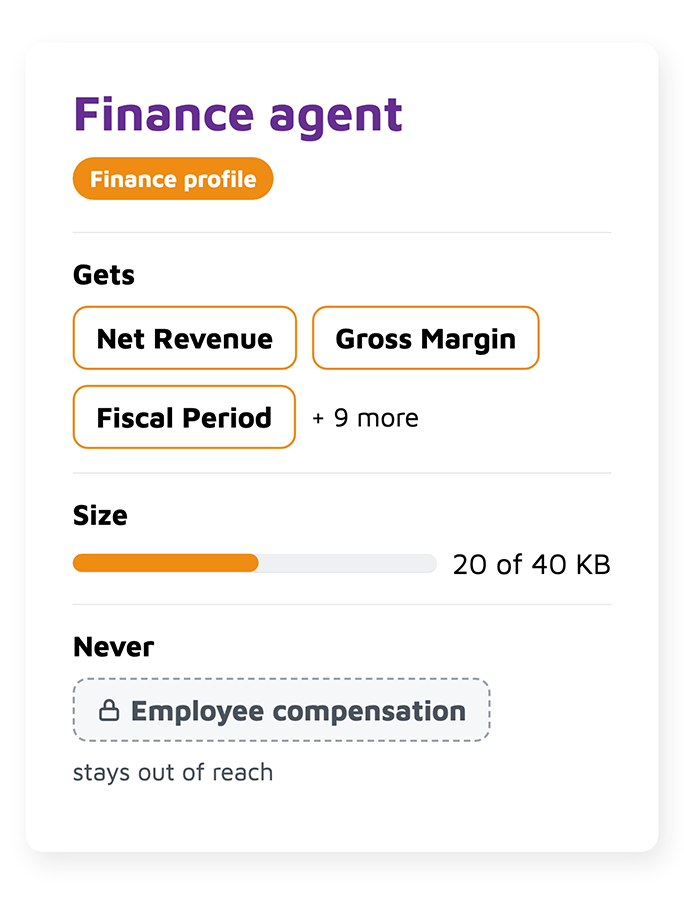
A profile decides what one agent receives when it connects: which parts of your company knowledge, how much of it, and what stays out of reach. A sales agent gets customers and pipeline, a finance agent gets revenue and margin, and neither sees salary data.
- Pick what each agent gets from your company knowledge
- See exactly what it will receive before it connects
- Set a size limit, so each agent stays focused
- Decide which agents may use each profile
The ECMP foundation
Five parts, and one connection for every agent.
- One place for your company knowledge. Your people write down terms, KPIs, data assets, reports and processes, and keep them current.
- An owner for every item. New items stay drafts until they’re published, flagged changes wait for an owner’s approval, and every change is kept in the history.
- Directions to the real data. Each dataset and report links to where it lives, and agents sign in there with the user’s own account.
- The right knowledge for each agent. Decide what each agent receives, set a size limit, and see exactly what it will get before it connects.
- One connection for every agent. Claude, Microsoft Copilot Studio and your own agents all connect the same way, through the MCP standard.