Life Cycle Assessment (LCA) is a powerful tool for enhancing sustainability, driving innovation, and enabling data-driven decision-making. It can guide how to improve operations, reduce costs, and strengthen your business. Nevertheless, embedding LCA in strategic business decisions is challenging due to high data intensity, methodological complexity, and resource constraints.
A single LCA can cost up to $100,000 or even more, depending on the complexity of the product, the depth of required data collection, and scope (e.g., environmental metrics included in the assessment). Furthermore, navigating the complexities of LCA often requires expert guidance and specialized software tools like SimaPro, Sphera (GaBi), and openLCA.
Organizations with limited experience in LCA typically reach out to external services for support when conducting their first LCA. However, as described in Sphera’s 2024 overview of LCA automation, when the number of LCAs increases, organizations move towards building up capacity by training in-house experts and licensing LCA software and databases to manually perform all relevant LCA steps, from data collection to LCA report production.
Over time, companies start to define clear processes and procedures, which act as the "connective tissue" for delivering systematic, efficient, and consistent LCAs, which is also a prerequisite for LCA process automation and scale-up.
What is LCA automation and scale-up?
The static nature of LCA results brings limitations to companies’ ability to adapt to continuously changing product designs, product portfolios, and supply chains. This is especially problematic for companies managing a broad range of products — sometimes thousands of SKUs — for which conducting the traditional LCAs is expensive and inefficient.
LCA automation enables organizations to perform LCAs across a full product portfolio with minimal manual input at high speed and high volume, moving beyond slow, manual, one-off studies. It allows organizations to automatically calculate the environmental impact of thousands of products across their entire life cycle in real time, enabling continuous, scalable, and data-driven insights for faster, evidence-based decision-making.
LCA scaling and automation with Lingaro
At Lingaro, we use technology to support clients in moving away from traditional manual LCAs towards LCA innovative automation platforms. We provide a scalable, end-to-end LCA infrastructure solution based on a cloud-agnostic architecture and dynamic visualization platforms that can be tailored to the specific product portfolio and company demand.
Key features of an LCA automation platform with Lingaro:
- Seamless Integration: dynamic data integration with the company’s existing ERP/PLM (Enterprise Resource Planning and/or Product Lifecycle Management) solutions, establishing an always up-to-date and single source of truth for data. Possibility to connect with other Ecodesign tools in the company ecosystem and external databases to ensure data accuracy and efficiency.
- Scalability: the ability to accommodate processes and combine large data volumes and requirements without sacrificing performance or accuracy and transform it into actionable insights for sustainable decision-making.
- AI-empowered: a platform supported by AI accelerators and algorithms (e.g., SVMs, ANNs, decision-tree based models, etc.) to handle LCA data gaps (e.g., missing characterization factors, material or process data), and to automatically match background databases (e.g., bill of materials inputs) to the most accurate LCA datasets and emission factors (e.g., Ecoinvent).
- Adaptive Methodologies: a flexible solution that can be adapted to multiple LCA methodologies (including specific LCA impact assessment methods) and different legal requirements and standards regardless of geographic location or industry-specific regulations.
- Accessibility and interpretation: an intuitive, user-friendly, and dynamic interface that displays complex scientific LCA results in an understandable manner so that even non-experts can understand and derive actionable insights from the analysis.
- Dynamic insights: a platform that provides dynamic and up-to-date information about environmental impacts of product portfolio, as well as any potential changes (e.g., what-if simulations) in product formulations, supply chain practices, end-userbehaviors and others. It is a powerful tool, deeply embedded in LCA science, for shaping the decarbonization, water reduction, and biodiversity conservation strategies at the organizational level and along the broader industry value chain.
How does the process work?
The process of developing an automated and scalable LCA platform is based on close collaboration with our customers, which is essential for delivering the product, service, and experience tailored to their individual needs and technical requirements. The exemplary process and technologies used for LCA automation platform development at Lingaro is presented in Figure 1.
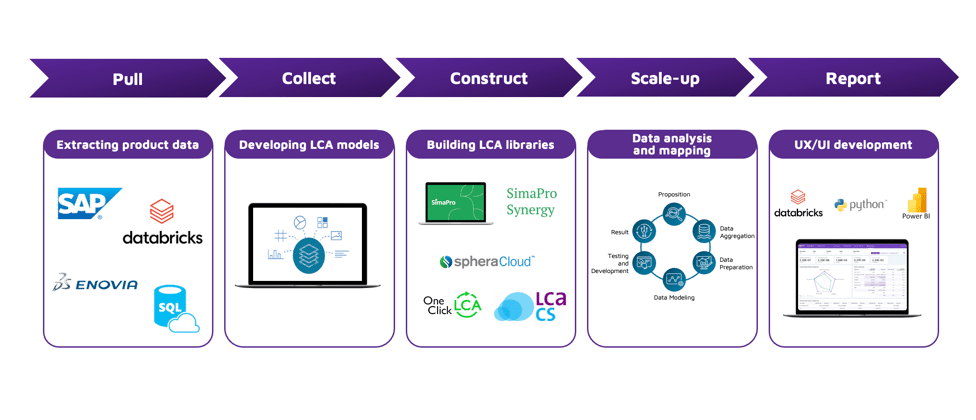
Figure 1 Exemplary process and technologies used for LCA automation platform development at Lingaro
Extracting relevant product data from company’s records
Lingaro’s LCA automated platform connects with the company’s existing ERP/PLM systems, which allows for bulk importing of relevant product data and specifications. Data lake extraction from ERP/PLM systems involves pulling structured, transactional data (e.g., BoMs, shipment data, energy and other production inventory data) into a scalable repository for analytics. This eliminates the need for manual input, saving time, and enabling organizations to reach actionable insights more quickly.
Developing LCA models
An integral and foundational part of LCA is modeling, which requires a combination of deep methodological expertise and, increasingly, technical skills to leverage automation. In the 2018 article How can we scale up LCA studies without compromising on quality?, PRé Sustainability emphasizes that a qualified LCA expert remains essential to the process, responsible for building models, selecting appropriate background data, and making sound methodological choices.
LCA is deeply embedded in science, and a knowledgeable person with ample experience in LCA who knows how to handle data gaps and quality issues and how to integrate, validate and interpret data will be an integral part of this process. Other, more time-consuming tasks (e.g., collecting some relevant data, minor adjustments in LCA model, creating individual reports) can be supported via technology (e.g., APIs, cloud platforms, AI).
At Lingaro we combine LCA expert knowledge relevant for building LCA models with technical automation skills to deliver an end-to-end solution to the client. Our LCA experts work closely with the client to collect relevant inventory data for building LCA models, handle data quality issues, and provide relevant recommendations to the technical team responsible for the process automation.
Building LCA libraries for enhancing scalability
In a conventional LCA, practitioners frequently encounter situations where they must build "one-off" or non-reusable models, often for bespoke products, specific processes, or regions, which cannot be easily adapted or reused by other LCA practitioners. Even if these models could be reused for future LCAs, other LCA practitioners may not be aware that they even exist. This is especially a major limitation in large organizations, where LCA practitioners are increasingly spread across diverse, specialized departments, transitioning from a solely environmental function to cross-functional teams integrated into product development, engineering, marketing, and strategy.
LCA automation and scale-up shifts this paradigm by moving from individual, project-specific LCA models to library-based, modular, or configurable LCA models. Instead of building a new individual LCA model for every single product or project – which is time- and resource-consuming – LCA libraries provide standardized pre-built databases that can be reused for multiple projects, product categories, or systems.
Once connected to configurable models, it is possible to make adjustments in materials, componentweights, and other variables (depending on the library structure and model parametrization) with minimum effort and cost, and thus enabling scalability, consistency, and faster, more efficient assessments.
There are multiple software solutions (e.g., SimaPro Synergy or Sphera Cloud) already available on the market, that allow not only on building individual LCA models, but also offer solutions for shared LCA libraries, configurable models, and APIs to scale from asingle product LCA to entire portfolio assessment.
Analyzing and mapping data
Lingaro scales the project by analyzing, mapping, and aggregating the data. The process involves the automated connection of product input data (such as BoMs, production inventories, and shipment data) from the ERP/PLM system with the appropriate LCAlibraries and models via API. This enables organizations to speed up the LCA process significantly (from months to even days), eliminates manual data entry, and reduces the risk of errors occurring.
Exploring the data and creating LCA reports
In the final step, our skilled developers connect to relevant data sources and software solutions and create a user-friendly interface (dashboard) that translates the complex LCA modeling and data into interactive visualizations, such as tables and graphs (e.g., bar, pie charts, and spider charts) with several sorting and filtering options (e.g., presenting impacts per specific life cycle stages, impact category, product, material, country, region, and so on).
The analytics dashboard (e.g., Power BI 2-in-1) is increasingly used to provide standardized, interactive, and actionable LCA reports, transforming complex environmental data into clear visualizations for sustainability reporting. These reports enable organizations to track key performance indicators related to carbon, water, and waste, ensuring compliance with international standards and facilitating informed, data-driven decisions. The analytics dashboard is an intuitive interface, requiring minimal learning, that enables organizations to explore the data by:
- Reporting LCA results - presenting the total LCA impacts across all life cycle stages for product portfolios;
- Identifying portfolio hotspots - pinpointing the most significant contributors to environmental impact within a product's life cycle, and;
- Running WHAT-IF simulations - exploring potential outcomes by changing variables, e.g., BoM and volume mix.
An example of such a dashboard for packaging for a Fast-Moving Consumer Goods company is presented in Figure 2.
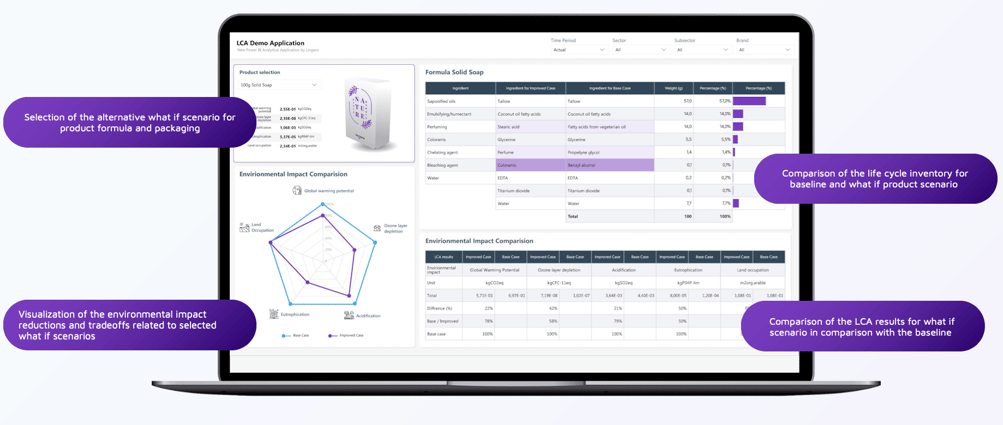
Figure 2 Example of dashboard user interface design for a FMCG company
Way forward
The landscape of sustainability assessment is evolving rapidly, but LCA is still the leading, scientifically robust, and internationally recognized method for evaluating environmental impacts. However, it is widely acknowledged that LCA is not without flaws, particularly regarding cost, time, and complexity.
LCA automation is a way forward to remove these flaws by shifting from manual, time-consuming methods to fast, scalable, and data-driven processes. By selecting the right LCA automation solution, businesses can navigate this transition smoothly, enhancing productivity and unlocking new opportunities and insights along the way.
FAQs
What is Life Cycle Assessment (LCA)?
Life Cycle Assessment (LCA) is a method that measures a product’s environmental impacts. It covers the full life cycle, from raw material extraction to end of life.
What stages does an LCA cover?
LCA typically assesses impacts from cradle to grave. It includes raw material extraction, manufacturing, distribution, use, and end-of-life stages in the product process.
Why is data collection critical for LCA?
Accurate data collection is essential to calculate potential environmental impacts and ensure reliable life cycle impact assessment across complex supply chains.
What challenges arise when conducting LCAs at scale?
Conducting LCAs across a large product portfolio is costly and time-consuming. This is due to complex data collection, evolving product design, and changing supply chains.
What is LCA automation?
LCA automation enables real-time life cycle impact assessment. It cuts manual work and helps organizations scale LCAs across their product portfolio.
How does LCA automation support product development?
By providing real‑time insights into potential environmental impacts, LCA automation supports faster product development and more sustainable product design decisions.
Can LCA automation support multiple supply chains?
Yes, automated LCA platforms continuously assess environmental impacts across dynamic supply chains and adapt to changes in materials, volumes, and processes.
Does LCA automation eliminate the need for experts?
No, expert knowledge remains essential for conducting LCAs, especially for modeling assumptions, interpreting life cycle impact assessment results, and ensuring data quality.
How is LCA used in environmental product declarations?
LCA provides the scientific basis for environmental product declarations by quantifying global warming potential and other life cycle environmental impacts.
How does real‑time LCA improve decision making?
Real‑time LCA allows organizations to instantly assess changes in product process or product design, enabling faster, data‑driven sustainability decisions.

%20article%20%E2%80%93%20blog%20coversdesktop.jpg?width=1200&height=712&name=2298%20Life%20Cycle%20Assessment%20(LCA)%20article%20%E2%80%93%20blog%20coversdesktop.jpg)