Scrap has long been one of the most persistent and expensive challenges in manufacturing resulting in an estimated $250B-$300B in lost profit. Whether caused by excess inventory, product obsolescence, quality defects, or shifting demand, scrap erodes margins and disrupts supply chains in ways that are often difficult to detect early.
Yet despite the scale of the problem, many consumer products companies and industrial manufacturers still manage scrap reactively. By the time the issue surfaces in operational reports or financial statements, the value has already been lost, eroding the bottom line.
A new generation of AI-driven decision systems is changing that dynamic. Instead of reacting to scrap events, manufacturers can now predict risks, intervene earlier, and continuously optimize inventory and production decisions.
Lingaro’s Scrap Optimization Response Agent (Scrap ORA) is designed to do exactly that.
The Hidden Cost of Poor Scrap Management
For manufacturers operating complex supply chains, scrap rarely emerges from a single root cause. Instead, it arises from a combination of factors that interact across planning, procurement, and production.
Common drivers include:
- Inventory, such as food component ingredients, that obsolete before it can be compounded
- Demand fluctuations that leave excess stock, spoiling on the shelves or in the distribution network
- Quality defects prevent raw materials or finished goods from entering production or supply chains
- Supply disruptions that force last-minute production adjustments lowering overall equipment effectiveness (OEE) by an estimated 10-25% in lost capacity
- Forecast errors that result in overproduction
When these signals remain uncoordinated across systems, companies often detect the problem only after financial losses never do.
The impact is significant. Excess inventory ties up working capital, while write-offs reduce profitability and create operational disruption. Planners spend countless hours manually analyzing inventory exposure, investigating root causes, and trying to prevent further losses, which by many estimates can exceed 20% of all material costs.
Without predictive visibility into scrap risks, manufacturers are effectively operating in a reactive mode - constantly responding to problems rather than preventing them.
Scrap Optimization in the Age of AI
The rise of advanced analytics and AI is enabling a more proactive approach to scrap management.
Instead of relying solely on historical reports, manufacturers can now continuously analyze operational signals across their supply chains, including inventory levels, demand forecasts, production plans, lead-time volatility, scrap rates and quality signals. Bringing these signals together requires a unified data foundation spanning platforms such as Azure Databricks, ADLS Gen2, Azure SQL, SAP ERP, and other operational systems.
By combining these signals with Databricks Mosaic machine learning models and optimization algorithms, organizations can identify potential scrap exposure well before it materializes.
In this model, scrap management evolves into a decision intelligence capability, where systems not only detect risk but also recommend actions to mitigate it.
For example, an AI system may identify that a particular stock keeping unit (SKU) is approaching end-of-life while demand is slowing. Instead of waiting for the inventory to expire, the system recommends actions such as production adjustments, promotions, or controlled discontinuation strategies.
This shift - from reactive reporting to proactive decision-making - is what defines the next generation of manufacturing intelligence.
How Scrap ORA Bridges the Gap
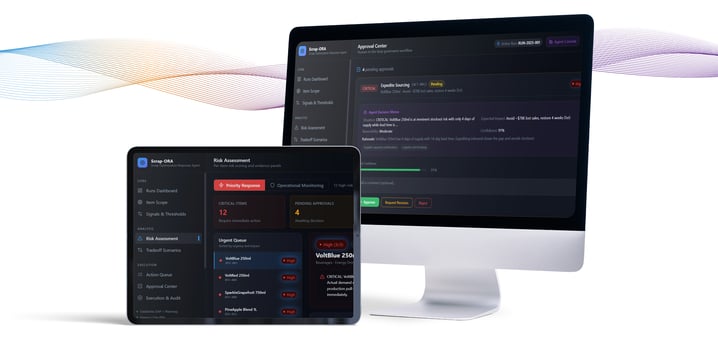
Lingaro’s Scrap ORA brings together predictive analytics, optimization outputs, and agentic-driven decision support to help manufacturers manage scrap exposure proactively.
The solution focuses on three core capabilities:
1. Scrap Prediction
Scrap ORA forecasts scrap probability, volume, and cost at the level of SKU, site, and time horizon.
Using operational data from enterprise systems, the agents, built on Azure Databricks, identifies early signals of risk such as end-of-life products, slow-moving inventory, expiry-driven write-offs, forecast errors, and lead-time volatility and can assign agents that keep monitoring, mitigating or prioritizing actions.
The system continuously evaluates thresholds and detects anomalies across enterprise signals, allowing organizations to identify potential scrap risks long before they appear in financial reporting.
2. Decision Intelligence
Prediction alone is not enough. Manufacturers need to understand why the risk is emerging and what the best response might be.
Scrap ORA therefore provides decision intelligence capabilities that:
- Explain risk drivers with evidence and confidence scores
- Deliver agents that quantify trade-offs between scrap, lost sales, and working capital
- Compare different mitigation scenarios, including optimized, conservative, and aggressive responses
This capability helps production planners, supply chain owners, and commercial strategy managers move beyond reactive firefighting and instead focus on strategic decisions supported by data.
3. Agentic Actioning
Perhaps the most powerful element of Scrap ORA is its ability to turn insights into actions with agents built on Azure Databricks.
The solution automatically generates mitigation actions from predefined playbooks and AI reasoning, such as production adjustments, inventory reallocations, promotions or markdowns, controlled product discontinuations.
Actions are prioritized based on risk level, financial impact, and operational constraints. Human in the loop approval workflows ensure high-impact decisions follow governance rules, while execution tracking provides a full audit trail.
Over time, the system learns from outcomes and continuously refines its playbooks and thresholds.
Why the Databricks Data Intelligence Platform Matters
Scrap ORA is built on the Databricks Data Intelligence Platform, which provides the unified data and AI foundation required to operationalize these capabilities at scale.
Modern manufacturing environments generate enormous volumes of supply operational data - from ERP systems and planning platforms to production telemetry and demand signals. Bringing these datasets together in a unified architecture is critical for reliable predictive analytics.
Within Azure Databricks:
- Delta tables provide curated data layers for scrap events, inventory signals, and planning data
- Feature stores and model registries support machine learning models for scrap and obsolescence risk
- Workflows orchestrate scoring pipelines, scenario runs, and action generation
- Lineage and monitoring capabilities ensure transparency and reliability across the system lifecycle
- Azure Databricks and Databricks workflows score, run scenarios, and deliver agentic action
By centralizing data engineering, machine learning, and orchestration in a single environment, Databricks enables Scrap ORA to operate as an integrated decision system rather than a collection of disconnected analytics tools.
Real Business Impact
Based on client benchmarks and engagements, the impact of a proactive scrap management approach can be substantial.
Organizations implementing Scrap ORA have observed improvements such as:
- 14% reduction in scrap through earlier detection of obsolescence risks
- 1.5% reduction in cost of goods sold driven by fewer write-offs and operational disruptions
- 8% improvement in lost-sales avoidance, as inventory is managed more effectively across at-risk SKUs
- 12% reduction in excess inventory exposure
- 22% improvement in planner productivity, as manual analysis and firefighting are reduced
While actual results depend on operational context and implementation scope, these benchmarks illustrate how predictive intelligence can transform scrap management from a cost centre into a strategic capability.
From Reactive Scrap Management to Intelligent Supply Chains
As manufacturing supply chains grow more complex, the cost of managing inventory, and maximizing OEE reactively continues to rise.
Scrap ORA represents a new approach—one that combines predictive analytics, AI-driven reasoning, and operational workflows to help organizations anticipate risk, respond earlier, and optimize outcomes.
By leveraging the Databricks Data Intelligence Platform, manufacturers can bring together the data, models, and decision processes needed to transform scrap management into a proactive, intelligence-driven capability.
The result is not just less waste, but a more resilient and efficient supply chain.
Explore how Lingaro’s data & AI capabilities in manufacturing and supply chains help consumer goods and discrete manufacturers increase sales, maximize OEE, and boost profitability: https://lingarogroup.com/services/intelligent-resilient-supply-chain



.png?width=768&height=248&name=Transportation%20Article%203.%201.3-(Compressify.io).png)