




What is agentic commerce? Agentic commerce is when AI handles shopping process for you, from figuring out what you need to comparing options and making the purchase. That means an AI assistant finding and ordering products on their behalf, whether through a brand‑owned direct‑to‑consumer (DTC) experience, a marketplace, or a third‑party AI interface.
While agentic commerce is reshaping consumer shopping, its impact is especially pronounced in B2B environments. Here, purchasing agents, procurement teams, category managers, and supply‑chain owners rely on AI to automate sourcing, compare suppliers, enforce contract terms, manage approvals, and trigger replenishment.
For DTC brands, AI increasingly mediates how consumers discover products, decide between alternatives, and complete purchases, often without directly visiting a brand website until execution is already determined.
This article covers both sides, buyers (consumers and B2B organizations) as well as the brands and suppliers they purchase from, because success in agentic commerce requires accuracy, control, and trust from every participant in the ecosystem, including brands that depend on DTC revenue and owned digital channels.
Key Takeaways:
- Agentic commerce is the buying journey where AI agents interpret intent, compare options, build baskets, and complete purchases on behalf of consumers and B2B buyers.
- Brands risk losing revenue not because demand disappears, but because AI systems silently exclude products with weak data, broken transaction logic, or unclear brand signals.
- Three capabilities determine success: being discoverable by AI, being transactable in real time, and owning the experience end-to-end.
- Major AI shopping interfaces, including ChatGPT, Perplexity, Google AI Mode, Amazon Rufus, and Microsoft Copilot, are beginning to influence or mediate purchase decisions in 2026.
- The fix is commercial readiness: clean structured data, integrated checkout systems, and governed first-party intelligence.
How does agentic commerce change the path to purchase?
For two decades, brands have competed for attention across websites, marketplaces, paid media, search, and mobile apps. That model is now facing extreme disruption. AI increasingly sits between buyers and brands in newly emerging journeys, shaping how consumers discover, compare, and ultimately purchase. For many brands, this shift has a direct commercial consequence: in some cases, products may no longer be discovered.
The buying behavior of intermediate buyers, procurement managers, vendor managers, and others has already changed. AI shopping experiences are now live in ChatGPT, Perplexity Shopping, Google AI Mode, Amazon Rufus, and Microsoft Copilot.
In parallel, major commerce platforms have begun formalizing agentic commerce protocols, including Shopify and Google’s Universal Commerce Protocol (UCP) and the Agentic Commerce Protocol (ACP) backed by OpenAI and Stripe, to enable AI systems to discover products, negotiate terms, and execute transactions safely and programmatically.
According to McKinsey & Company’s October 2025 report, The Agentic Commerce Opportunity, “44% of users prefer AI-powered search. They say it is now their main way to search online. This compares with 31% who prefer traditional search.”
The path to purchase is moving from random clicks and unstructured browsing toward curated conversations, AI overviews, and delegated decisions. AI-led discovery no longer just provides insight; it executes. Agents compare options, build baskets, and check out automatically, combining discovery, choice, and payment into a single flow.
For brands, the implication is direct: if AI systems cannot reliably understand and trust your product data, your products may never appear in the consideration set. AI answers filter out incomplete or inconsistent information and favor competitors with clearer signals.
Traditional commerce vs. Agentic commerce
|
Dimension |
Traditional commerce |
Agentic commerce |
|
Discovery |
Search rankings, ads, browsing |
AI synthesis and recommendation |
|
Decision driver |
Human evaluation of options |
Agent evaluation of structured data |
|
Conversion path |
Multi-step, click-driven |
Single delegated action |
|
Success metric |
Traffic, rankings, CTR |
Inclusion in AI answer sets |
|
Data requirement |
Human-readable content |
Machine-readable structured data |
|
Customer relationship |
Direct (brand-owned) |
Often mediated by AI platform |
What this shift means for brands
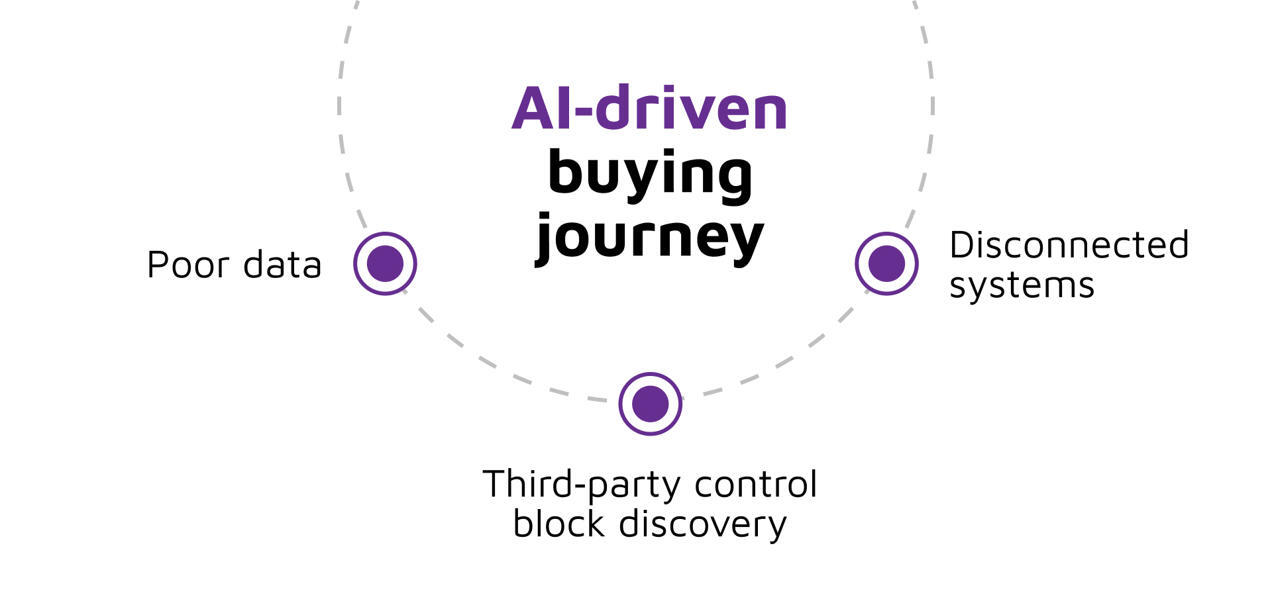
Disconnected pricing, inventory, or checkout systems stop AI-driven demand from converting because intent-driven recommendations cannot be consistently priced, accurately fulfilled, or reliably completed at checkout without integrated commerce execution layers, leading conversion leakage and constraining the value organizations can realize from AI- and agent-driven commerce.
This risk applies equally to DTC brands whose storefronts appear technically functional to humans, but whose backend systems cannot reliably support AI‑initiated handoffs, identity context, or real‑time validation.
As AI-assistants control more of the buying process, brands may lose their direct relationships with customers because third‑party AI platforms insert themselves between the brand and the customer at every critical interaction point. They may also lose insight into customer behavior. They risk the erosion of their margins and long‑term AI‑driven visibility, especially when DTC experiences are bypassed or abstracted behind AI intermediaries.
This raises a practical question for leaders: What does agentic commerce actually change in day‑to‑day buying? And how should organizations evaluate the impact without getting caught up in hype or tooling? The sections below explain this new AI-driven buying journey and describe three capabilities brands must have to compete in AI-powered product discovery environments.
What blocks brands from competing in agentic commerce?
The central issue is that many organizations are not yet data ready, organizationally ready, and AI ready for AI‑driven buying journeys. Agentic commerce does not fail because AI lacks capability, but rather because the underlying commercial system isn’t ready.
Across industries, the most common blockers look like this:
- Breakdown in content discoverability. Classic SEO and digital shelf strategies target human browsing and search engine rankings. AI assistants don’t show a page of results, they synthesize answers and recommend only a few options, so brands that rank well for humans can still be invisible in AI‑generated answers. This directly reduces inclusion in AI‑generated consideration and recommendation sets.
- Fragmented product and brand data. Inconsistent product titles, attributes, images, and descriptions across channels, reduce trust for buyers and AI systems, weakening data confidence and brand relevance.
- Weak transaction readiness. AI‑generated traffic is often highly purchase‑ready, but many brands lack the systems needed to convert that intent into a transaction. But if your team doesn’t align inventory, promotions, shipping logic, pricing, and checkout, conversions drop. The result is silent revenue leakage – intent exists, but AI cannot confidently execute the purchase.
- Lack of real-time confidence. Many commerce stacks run in data and infrastructure silos, creating data errors, latency leading to search, supply chain, and fulfilment inaccuracies.
- Unclear ownership of the customer relationship. Third-party AI platforms have become a new buying interface, defacto becoming the source of first-party data. Brands then lose visibility into intent signals, behavior data, and customer lifetime value.
Viewed in aggregate, these are not challenges rooted in AI itself. They’re commercial readiness problems, exposed by AI. A practical mental model: the three pillars of the AI path to purchase.
The three pillars of the AI path to purchase
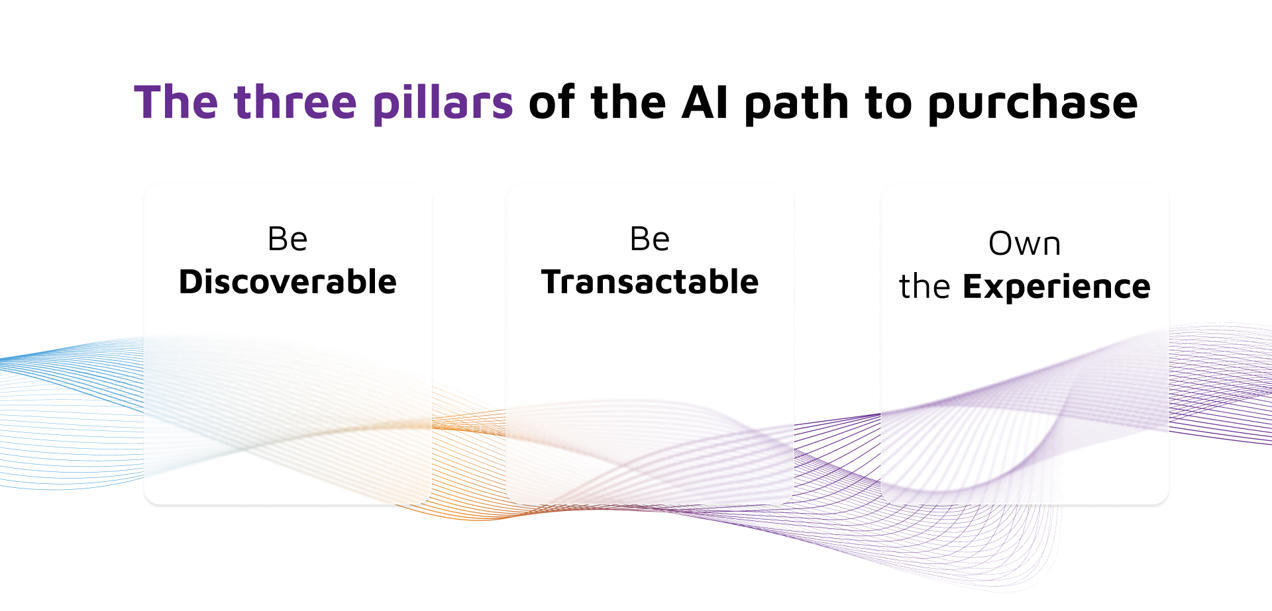
A useful way to operationalize agentic commerce is to group it into three outcomes, each mapping to a part of the AI-mediated journey:
Lingaro approaches agentic commerce as a portfolio of services and solutions, not a single platform or product, focused on foundations, governance, and measurable business outcomes rather than experimental hype.
Lingaro’s AI Path‑to‑Purchase framework uses three pillars:
- Be Discoverable: AI systems can confidently recommend you.
- Be Transactable: Demand converts the moment AI decides a buyer is ready.
- Own the Experience: You retain control of the agents that are foundational to a relationship, data, and economics.
You don’t have to tackle everything at once. The point is to understand where you’re exposed, and which pillar is the fastest path to measurable improvement.
Pillar 1 - Be Discoverable
Can AI systems confidently recommend your product or brand?
In agentic commerce, discovery no longer happens through browsing. It happens through AI selection, where only a few qualified options are surfaced, and everything else is ignored. If AI assistants cannot confidently recommend a product or brand, no later optimization will matter.
Keyword rankings matter less than whether AI systems can accurately interpret and trust your content and decide you belong in the answer. That means your product data, attributes, and brand information must stay consistent, detailed, and machine-readable, not just on your own site, but across the wider web. AI systems aggregate and validate information from multiple sources, including earned media, partner sites, reviews, third-partylistings, and authoritative publications.
AI systems do not rely solely on your own website. They heavily validate product claims and relevance through offsite and earned media signals, such as consistent mentions in reviews, authoritative publications, retailer listings, and third‑party sites.
Inconsistent data across these sources (for example, conflicting ingredient lists or outdated pricing on different platforms) lowers AI confidence and can cause the product to be excluded from recommendations entirely. Brands must therefore ensure product information is not only well‑structured on‑site, but also consistent and reinforced across the wider web.
In practice, AI systems evaluate specific signals such as product attributes, constraints, and eligibility rules, not just descriptive content. Conflicts between sources (for example, mismatched specifications, outdated claims, or inconsistent naming across channels) reduce confidence and can exclude a product entirely, even when demand exists.
For example, if a shopper asks for “healthy lunchbox snacks under $10,” products appear based on structured product data. This data includes ingredients, pack size, nutrition claims, and value messaging. They appear because the data is clear and readable and reinforced by consistent third-party references that confirm those claims, not because a page ranked well in classic search.
Discoverability often breaks not at the level of visibility, but at the level of validation, when AI systems cannot reconcile pricing thresholds, dietary claims, availability, or compliance signals across sources in real time.
“It’s no longer a marketing‑only game; it’s a data, content, and offsite trust problem.”
Without credible external citations, even well-structured, on-site content may be treated by AI systems as incomplete or unreliable. For leaders, this shifts the question from “How do we rank?” to “Where does our data lose credibility, consistency, or corroboration as it moves across the ecosystem AI relies on to make recommendations?”
Pillar 2 - Be Transactable
Can your systems accept and execute AI‑generated intent, whether the purchase occurs through DTC checkout, marketplace flows, or embedded AI experiences?
Being recommended by an AI agent is only valuable if that intent can be executed without friction. This is where many brands lose sales in agentic commerce.
Two key protocols power these handoffs today:
- UCP (Universal Commerce Protocol), developed by Google and Shopify, covers the full shopping journey, including product details, cart building, and checkout.
- ACP (Agentic Commerce Protocol), developed by OpenAI and Stripe, focuses on secure, instant checkouts inside conversational AI experiences.
Identity handoff is already possible today. AI agents can securely pass buyer context (such as identity, preferences, shipping details, B2B contract terms, or approval rules) using OAuth-based mechanisms, enabling more personalized and governed transactions, including authenticated DTC purchases without manual re‑entry of data.
However, success still depends heavily on the brand’s own systems.
Concrete failure example: An AI agent recommends the ideal product and confirms availability. But at the moment of purchase, it encounters a stock mismatch, pricing discrepancy, or fails to properly link the buyer’s identity. The agent immediately drops the product and chooses a competitor that offers a smoother handoff. Revenue is lost silently, regardless of whether the brand sells DTC or through intermediaries.
The bottom line: Protocol support is important, but brands must also align their backend systems (real-time inventory, pricing, checkout, and identity reconciliation) to reliably receive and act on AI-generated demand.
Pillar 3 - Own the Experience
Can you automate and sustain AI‑driven buying decisions while retaining control over DTC relationships, data, and economics?
Ownership is the pillar with the highest long-term ceiling. It focuses on retaining control of customer relationships, first-party data, pricing logic, promotion rules, and automated decision-making instead of depending entirely on third-party AI platforms to mediate those decisions for you.
Importantly, ownership is not required to participate in agentic commerce at a basic level. Brands can achieve discoverability and even early conversion through structured data, marketplace integrations, and external AI interfaces alone.
However, as AI‑mediated buying becomes a material revenue channel, relying exclusively on third-party AI systems limit control, insight, and differentiation, particularly for DTC brands whose profitability and loyalty depend on owned engagement and repeat purchase behavior.
What owning the experience means in practice:
- Controlling first-party customer and transaction data
- Governing your own pricing, assortment, bundling, and replenishment logic
- Running automated agentic workflows under your brand’s rules and policies
- Maintaining visibility, traceability, and influence across the entire buying journey
Most brands will use a hybrid approach: leveraging external AI interfaces for broad reach while building owned experiences for strategic parts of the journey. This protects long-term margins, data ownership, and commercial control, especially in DTC scenarios where customer lifetime value matters.
Ownership matters at scale when brands rely solely on third-party AI platforms such as ChatGPT, Google Gemini, or marketplace‑embedded AI to drive discovery and purchase decisions.
They often lose visibility into early intent signals, have reduced influence over pricing and bundling logic, and face a higher risk of margin erosion. Owned experiences allow organizations to protect margins, enforce commercial rules, retain customer insight, and create differentiated journeys that competitors cannot replicate.
B2B Example: In B2B environments, an CPG-owned portal can evolve from a simple ordering page into an AI-assisted workspace for a retailer. Retail purchasing managers receive proactive restocking alerts, auto-generated purchase recommendations, pricing and budget guidance, contract compliance checks, and automated approval routing, all governed by the brand’s own rules and policies.
At scale, sustained competitive advantage comes from owning not just the interface, but the rules, data, and feedback mechanisms that shape buying decisions over time.
Where leaders should start
Agentic commerce success depends on three pillars: Be Discoverable, Be Transactable, and Own the Experience. You don’t need to fix everything at once. Start with the area that creates the biggest risk or opportunity for your business.
Here’s where we recommend you start:
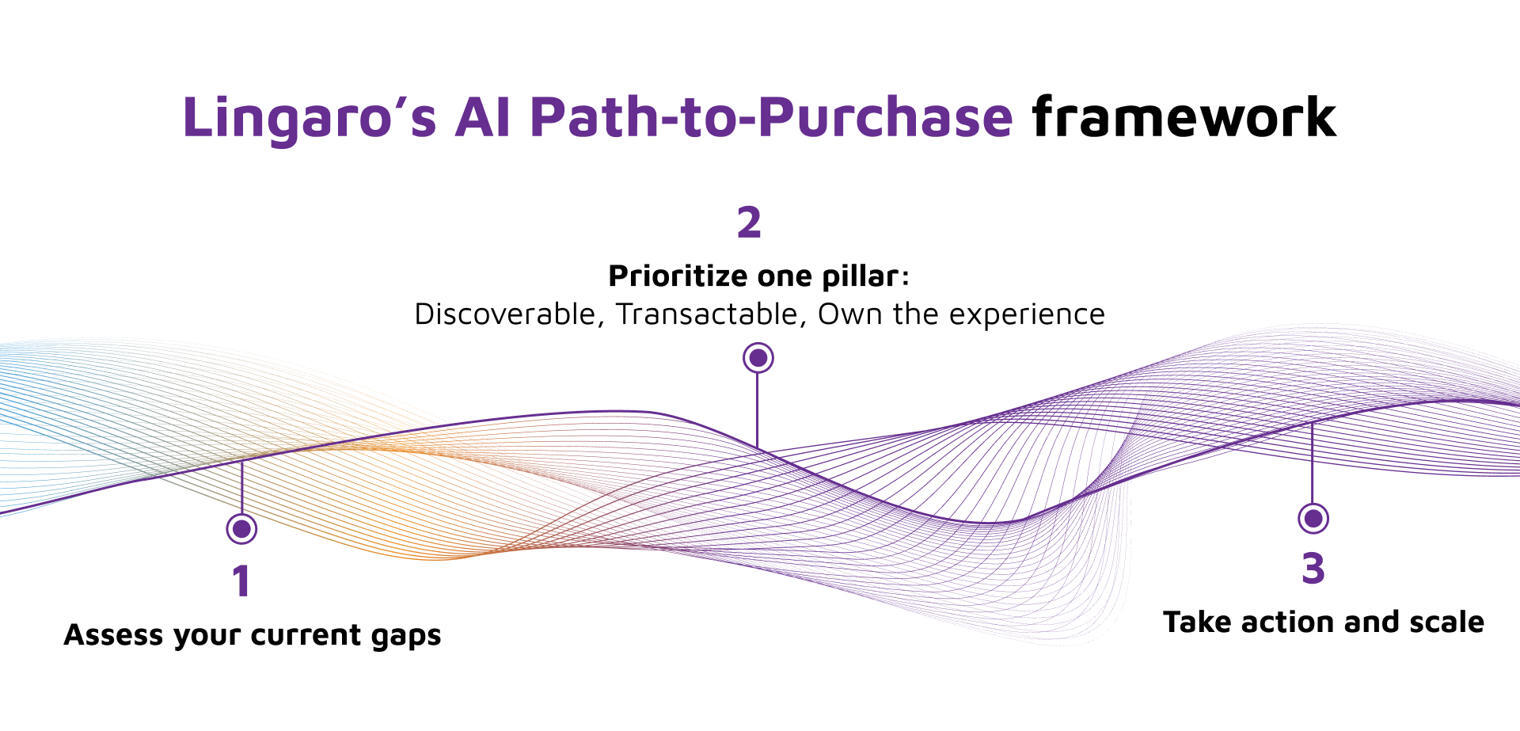
1. Assess your current gaps: Review where your products appear (or don’t appear) in AI recommendations, whether AI agents can successfully complete purchases on your site, and how much control you have over customer data and decisions.
2. Prioritize one pillar
- Discoverable: Improve structured data and ensure consistency across your own channels and offsite sources (reviews, retailers, earned media) so AI systems confidently recommend your products.
- Transactable: Make your checkout, inventory, and pricing ready for AI handoffs (UCP/ACP protocols and identity linking).
- Own the experience: Build or strengthen owned journeys so you retain customer data, margins, and control.
3. Take action and scale: Fix the chosen pillar, then expand. As your AI-driven volume grows, implement a unified intelligence layer (such as Databricks) to keep data synchronized and decisions governed.
Once leaders understand which pillar presents the biggest risk or opportunity, the next step is to move from diagnosis to execution, without over‑investing or locking into premature tooling decisions.
Lingaro helps brands operationalize agentic commerce pillar by pillar. We start with an AI readiness and AI visibility (AEO) audit to identify where products or services break down across AI discovery, transaction execution, or experience ownership.
From there, we help organizations strengthen the weakest pillar first, by cleaning and governing product and brand data, preparing systems for UCP and ACP handoffs, and designing scalable owned experiences where it creates the most commercial value.
The goal is not to “do everything at once,” but to reduce risk, restore visibility, and convert AI‑driven demand where it matters most today, while building a foundation that scales as agentic commerce volumes grow.
FAQs
What is the AI path to purchase?
The AI Path to Purchase is the end-to-end buying journey where AI agents handle discovery, evaluation, decision-making, and execution on behalf of the buyer.
How does agentic commerce differ from traditional eCommerce?
Agentic commerce shifts from human-driven browsing and clicking to AI agents that interpret intent, compare options, and execute purchases with minimal human input.
What role does agentic AI play in buying decisions?
Agentic AI can interpret intent, compare options, and progress the customer journey with limited human input.
Why are brands losing visibility in AI journeys?
Brands lose visibility in AI journeys when AI search favors trusted, well‑structured data over classic ranking factors.
Where do buyers encounter products in this new model?
Buyers increasingly discover and evaluate products through AI interfaces (such as ChatGPT, Perplexity, and Google AI Mode) rather than traditional websites or marketplaces.
What determines whether AI recommends a product or service?
Whether AI recommends a product or service depends on the quality and consistency of the product data.
Why does structured data matter more than content volume?
Structured data matters more than content volume because AI systems rely on it to evaluate relevance and constraints accurately.
How fast can AI‑driven demand convert?
AI‑driven demand converts in real time when you align pricing, inventory, and fulfillment.
Who is most affected by the shift to commerce shaped by AI?
Brands, category managers, procurement teams, and marketing leaders are most affected, as they must adapt to AI-mediated discovery, conversion, and customer ownership
What replaces rankings and links as the core success metric?
Inclusion in AI answers and recommendations replaces rankings and links as the primary success metric.