Sustainability reporting tools are becoming the operating layer for trusted ESG data, audit-ready disclosures, and performance insight. The right ESG reporting software helps teams connect fragmented systems, standardize data, reduce manual work, and report with confidence. Lingaro’s experience shows that the biggest value comes from combining corporate sustainability reporting expertise with a governed sustainability data foundation, not simply buying another tool.
Key summary
-
Sustainability reporting is moving from spreadsheet-based compliance to governed, audit-ready data management.
-
The best sustainability reporting tools centralize data, preserve traceability, and reuse disclosures across multiple frameworks.
-
ESG reporting software should fit into the existing technology landscape instead of creating another disconnected data silo.
-
A strong ESG data management platform helps organizations improve reporting quality, reduce manual effort, and support business decisions.
-
Lingaro helps companies build corporate sustainability reporting foundations that combine sustainability expertise, data integration, analytics, and adoption support.
Why sustainability reporting tools are now a business priority
Sustainability reporting has become too complex for disconnected spreadsheets, manual uploads, and one-off processes. Organizations must manage more ESG data, meet evolving regulatory demands, and provide credible disclosures to auditors, investors, customers, and internal leaders. That makes sustainability reporting tools a strategic investment, not just a compliance convenience.
For many enterprises, the challenge is not a lack of data. It is that data sits across ERP systems, procurement platforms, HR systems, supplier files, external datasets, local spreadsheets, and legacy reporting tools. Each team may use different definitions, owners, validation logic, and timelines, so the same data point may be collected and adjusted several times.
Modern ESG software and reporting solutions need to support the full reporting cycle: ingestion, validation, transformation, ownership, documentation, audit trails, dashboarding, and reuse across standards. The goal is to create a trusted sustainability data layer for compliance, performance management, and long-term strategy. This also gives sustainability, finance, IT, and business teams a shared source of truth instead of separate versions of the same report.
The problem with fragmented ESG data
Fragmentation is one of the biggest barriers to reliable corporate sustainability reporting. When data sits in many places, teams spend too much time collecting and reconciling information instead of using it to understand performance. It also increases inconsistency when organizations report against multiple frameworks such as CSRD, ESRS, GRI, CDP, SASB, ISSB, EPR, or local regulations.
A fragmented setup also weakens audit readiness. If teams cannot show where a data point came from, who changed it, when it changed, and which calculation logic was applied, confidence drops. Audit preparation then depends on manual explanations rather than system-based evidence.
Lingaro SharePoint materials describe this pattern across large organizations: overlapping standards, outdated processes, fragmented systems, and limited traceability create a costly reporting model. In one ESG Reporting Software study, the client needed help evaluating vendors because ambitious ESG goals, legacy processes, and changing reporting demands made it difficult to choose the right path.
What to look for in ESG reporting software
Choosing ESG reporting software should start with the organization’s reporting model, data landscape, and assurance needs. A strong tool should not simply create a better-looking report. It should help teams manage sustainability data as enterprise data, with clear controls, reusable mappings, and flexibility to scale as requirements change.
Start with integration. The platform should connect to existing systems instead of forcing every process to be rebuilt. Then prioritize governance: role-based access, ownership, approvals, validation rules, change logs, and documentation. Finally, assess framework flexibility, so teams can map data once and reuse it across mandatory and voluntary reporting standards.
Auditability and usability matter too. Every reported figure should be traceable from source to disclosure, and business owners, sustainability teams, data teams, finance, and auditors must be able to use the system confidently. Even the best sustainability management software can fail if adoption is weak.
Why an ESG data management platform matters
An ESG data management platform provides the foundation reporting tools depend on. It connects data sources, standardizes definitions, applies controls, and makes information available for disclosures, dashboards, analysis, and decisions. Without this layer, organizations may add new reporting interfaces while leaving the underlying fragmentation untouched.
Reporting outputs are only reliable when the data behind them is reliable. A strong platform preserves raw inputs, maintains lineage, supports historization, applies business logic, and automates quality checks. It should also make exceptions visible, so teams can resolve missing values, inconsistent units, or late submissions before they affect final disclosures. That turns sustainability reporting from a recurring scramble into a repeatable operating model.
Lingaro’s sustainability success stories include centralized ESG and sustainability data lakehouse work focused on a single source of truth, transparency, audit readiness, and scalable reporting. In one corporate sustainability reporting example, centralized data architecture, automated transformation logic, validation rules, historization, and manual submission interfaces helped create a more reliable ESG data foundation.
How better sustainability reporting tools create business value
The value of better sustainability reporting tools is not limited to compliance. When reporting data becomes trusted and reusable, organizations can make faster decisions, improve transparency, and connect sustainability performance to operational and financial priorities. Teams spend less time chasing numbers and more time identifying actions.
Lingaro materials point to measurable business impact from unified sustainability reporting foundations, including faster reporting preparation, reduced manual entry, more than 200 data points managed per standard, and coverage across more than 20 jurisdictions. These outcomes show why tools should be judged by their ability to reduce workload and improve confidence in reported data.
For global organizations, this matters because requirements will keep evolving. New frameworks, assurance expectations, and stakeholder demands will add complexity. A flexible, governed sustainability data foundation helps organizations adapt without restarting the reporting process every year. It also makes it easier to extend reporting into dashboards, internal performance reviews, supplier engagement, and leadership decision-making.
Common ESG reporting approaches
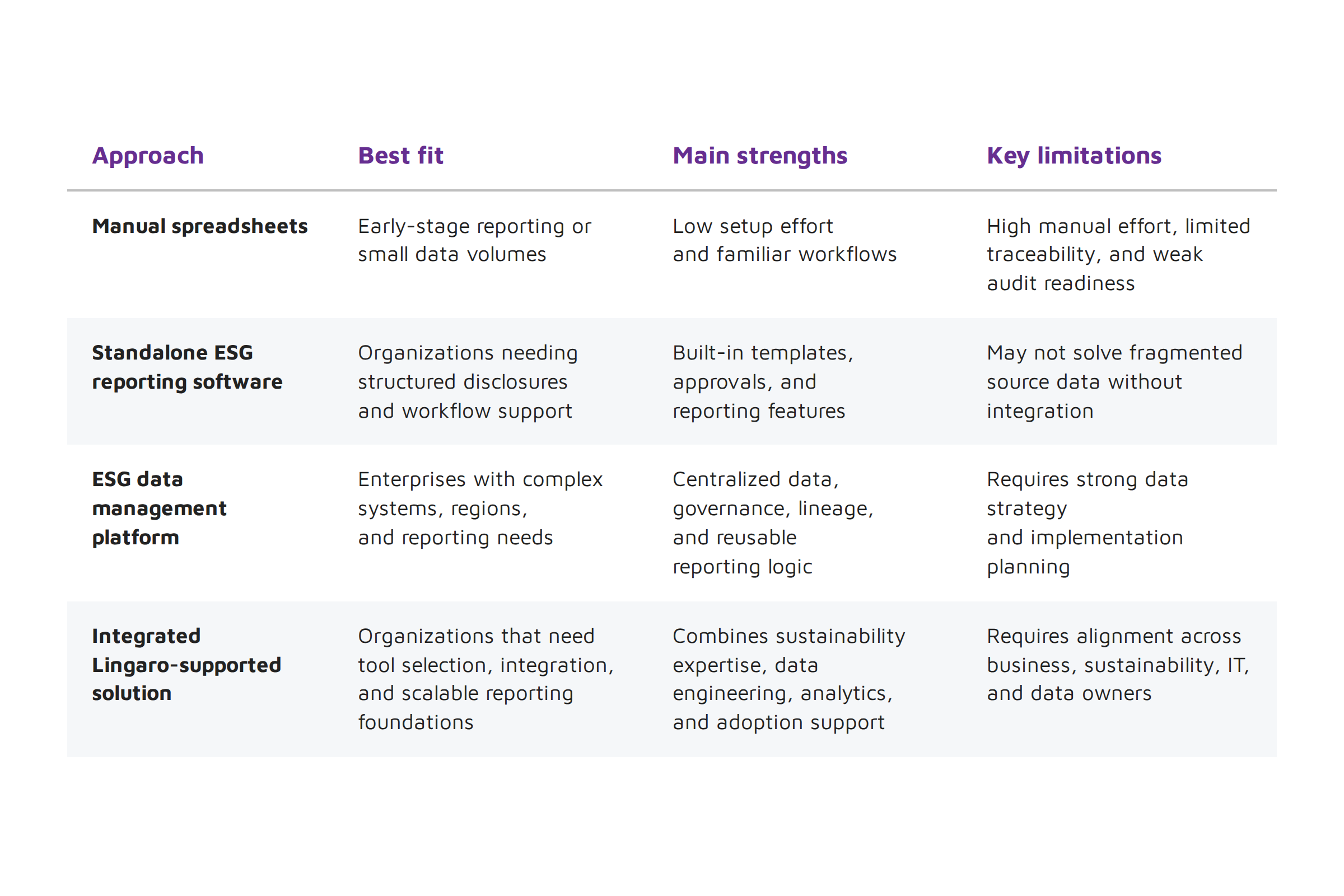
Build, buy, or integrate: choosing the right approach
There is no single best approach. Some companies need a custom sustainability reporting hub. Others may benefit from a third-party ESG reporting software provider. Many mature organizations need a hybrid model: central data architecture plus selected SaaS capabilities for reporting, disclosure, or workflow needs.
The key is to avoid treating software procurement as a shortcut around data strategy. Lingaro’s ESG Reporting Software study evaluated roughly 100 potential providers and delivered a three-vendor shortlist, ROI estimates, workshops, and an integration blueprint. This helps organizations compare vendor claims against reporting needs, data maturity, and business case.
A practical decision process should answer four questions: What data foundation is required? Which frameworks and jurisdictions must be supported? Which workflows need automation, approval, and audit trails? And how will the solution fit into existing technology, governance, and reporting cadence? Answering these upfront helps avoid overbuying, underbuilding, or selecting a tool that cannot scale with future reporting needs.
How Lingaro can help
Lingaro helps organizations move from fragmented sustainability reporting to trusted, audit-ready data foundations. We combine sustainability and compliance expertise with data strategy, engineering, visualization, AI, and adoption support. That means we can help clients select ESG reporting software, integrate third-party tools, build bespoke reporting hubs, or create central sustainability data lakehouses.
Lingaro’s Sustainability Reporting Hub focuses on managing reporting in one place, reducing manual data entry, centralizing documentation, automating workflows, improving visibility into sustainability goals, and lowering compliance risk. It can support regulatory and voluntary requirements, role-based user management, audit trails, and progress tracking.
We also support sustainability SaaS procurement and integration, including vendor criteria, evaluation, data risk assessment, ROI estimates, and implementation blueprints. For complex data environments, Lingaro can build client-owned sustainability data platforms that connect internal systems, flat files, external data sources, dashboards, and reporting workflows into one governed architecture.
The result is more than better reporting. It is a more reliable way to manage sustainability performance, shorten reporting cycles, improve audit readiness, reuse disclosures across frameworks, and give leaders clearer insight into risks, progress, and opportunities. With the right operating model, sustainability data can become useful throughout the year, not only during disclosure season.
Final thoughts
Sustainability reporting is becoming a test of data maturity. Companies that invest in integrated sustainability reporting tools, governed data foundations, and adaptable ESG reporting software will be better prepared to report with confidence and manage sustainability as a business performance issue.
The next step is not simply choosing a tool. It is building a reporting model that connects systems, people, controls, and insights. With a strong ESG data management platform and the right implementation partner, sustainability data can become a strategic asset.
FAQ
What are sustainability reporting tools?
Sustainability reporting tools help organizations collect, manage, validate, and report ESG data.
Why do companies need ESG reporting software?
They need it to improve reporting accuracy, traceability, efficiency, and audit readiness.
What is an ESG data management platform?
It is a governed data foundation that connects ESG sources and prepares trusted data for reporting.
How does sustainability management software support compliance?
It helps standardize workflows, document evidence, and reuse data across reporting frameworks.
How can Lingaro help with corporate sustainability reporting?
Lingaro helps companies design, build, integrate, and scale trusted sustainability reporting solutions.

%20article%20%E2%80%93%20blog%20coversdesktop.jpg?width=1200&height=712&name=2298%20Life%20Cycle%20Assessment%20(LCA)%20article%20%E2%80%93%20blog%20coversdesktop.jpg)