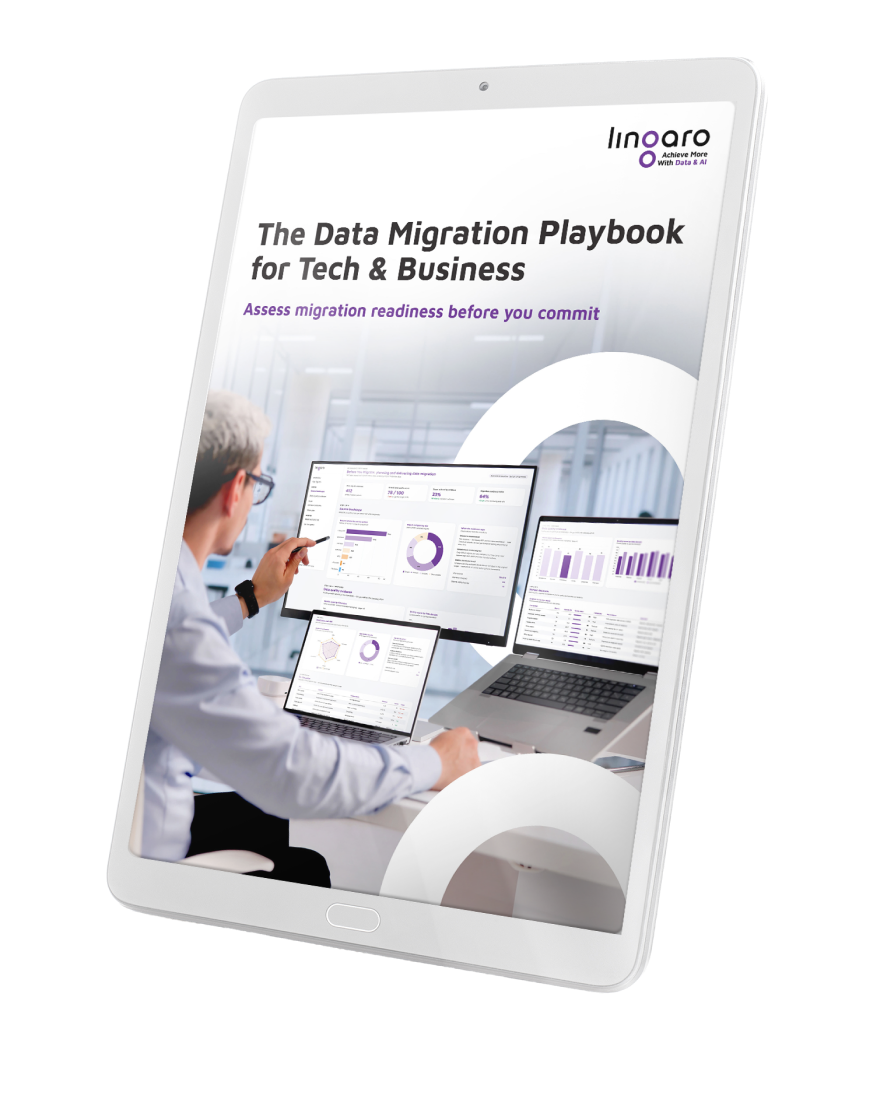
Most data estate migrations are planned as a move. The ones that produce AI-ready data are designed as a destination first. Here is what that destination must contain, and how to know what you are actually migrating.
Key takeaways:
-
Migration moves workloads. Modernization changes what data can be used for. Only the second makes AI possible.
-
“AI-ready” is testable: an agent should resolve a business term to a governed asset without human interpretation.
-
The expensive risk is moving undocumented business logic you did not know existed.
-
Equivalence testing, not code conversion, is where migration programs lose their schedule.
-
The method is the product. Source and target platforms are configuration, so the same framework can support platform exits, infrastructure consolidation, and BI migration.
-
AI substitution compounds across waves, from roughly 40% in the pilot to around 70% by the fourth. Treat any single headline automation number with suspicion.
Data modernization is no longer optional
Migration is not the goal. It is one step in a broader modernization journey.
The real objective is a governed, trusted foundation that supports analytics, AI, and long-term growth.
.jpg?width=960&height=200&name=KM%20250826%20Factory%20campaign%20TECH%20Article%20-%202777%202%20(1).jpg)
What are we migrating toward?
“AI-ready” is testable: can a system, not a person, resolve a business question to a governed physical asset and defend the answer? The target architecture therefore needs five elements by design:
-
A semantic layer. Business terms are defined once and reused across every dashboard, notebook, and agent.
-
Catalog-level governance. Access, masking ,and classification apply to the asset itself, whichever tool or agent touches it.
-
Machine-readable, column-level lineage. Agents need an end-to-end path to explain where a number came from.
-
Owned data products and contracts. Named owners, declared schemas, quality SLAs and consumer contracts make change predictable.
-
Cost governance. A technically correct but economically unpredictable platform will not scale with business demand.
These capabilities do not emerge from lift-and-shift. They are architectural decisions, and they are cheapest before the first workload moves.
The biggest migration challenges happen before migration begins
Once the target state is defined, organizations need a clear view of their current estate. Without that visibility, they risk modernizing complexity rather than removing it.
.jpg?width=960&height=200&name=KM%20250826%20Factory%20campaign%20TECH%20Article%20-%202777%205%20(3).jpg)
Challenge 1: You cannot scope what you cannot see
Without usage telemetry and dependency analysis, organizations cannot distinguish critical assets from redundant ones. The first deliverable should be a complete inventory of assets, dependencies, consumers, and embedded logic.
Challenge 2: The business logic is not in the documentation
Legacy transformations and calculations often contain undocumented business rules. Extracting that logic and validating outcomes through equivalence testing must be planned from day one.
On a recent SAP BW-to-Databricks program covering 666 reports across 16 European markets, every migrated model was reconciled with source output at country and monthly granularity. Discrepancies were flagged before deployment. The reconciliation harness, not code generation alone, made the schedule predictable.
Challenge 3: Planning based on assumptions delays value
Effort should be modelled from procedural logic, dependency depth, source count, quality debt, and ownership. This creates a defensible estimate, a rational wave sequence, and an early decision on what to retire rather than migrate.
How mature organizations turn modernization strategy into execution
Successful organizations do not begin with code conversion. They begin with visibility. They define the future state, understand the current environment, and use evidence to drive every modernization decision.
This is the principle behind Lingaro's Migration Factory.
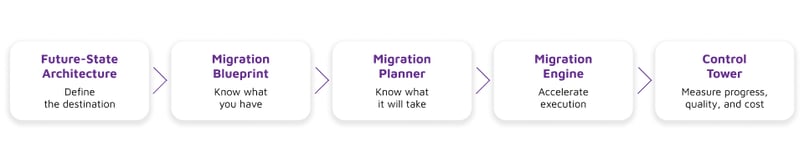
Step 1: Define the future-state architecture
Specify the semantic layer, catalog governance, lineage, product ownership, and cost model so every migration decision can be reviewed against a clear destination.
Step 2: Understand reality before committing budget
Migration Blueprint turns discovery into a structured, versioned knowledge base: source documentation, target architecture, and mapping rules held alongside the code that will implement them.
Step 3: Build a roadmap based on evidence
Migration Planner uses metadata, dependency analysis, and complexity scoring to create evidence-based migration plans. Sequencing follows dependency order, starting with foundational and shared domains before downstream workloads, while identifying assets that can be retired rather than migrated.
Step 4: Automate what is deterministic, review what is not
Migration Engine applies eight AI agent roles across code generation, testing, reconciliation, documentation, and assessment. Architectural decisions, business-rule interpretation, and remediation remain with engineers. Every task follows branch, test, review, and approval controls, ensuring full accountability.
AI does the typing. Humans do the thinking. Measured substitution rises from roughly 40% in the pilot to around 70% in later waves.
Step 5: Govern progress with complete visibility
Control Tower tracks progress by wave, dependencies, test coverage, equivalence results, open remediation, and the target platform’s consumption-cost profile, allowing teams to correct decisions while change is still inexpensive.
Anything to anything: agnostic by architecture, not by aspiration
Migration Factory separates method from platform-specific implementation. Around 80% of a migration consists of reusable activities such as discovery, planning, quality controls, reconciliation, and governance. The remaining 20% is platform-specific and implemented through plugins, allowing the same framework to support multiple migration scenarios.
The scenarios below are indicative of delivered engagements, not scoping commitments.
| Migration scenario | Typical scope | Typical scale |
| Data platform | Full platform exit (e.g., SAP BW, Teradata, on-premises data warehouse) | 500-2,000+ objects; 14-36 months |
| Data | Historical volume, historization, reconciliation, and quality debt | Sized by data volume and number of source systems |
| Infrastructure | Pipelines, orchestration, and compute layers, with no BI layer in scope. Typically cloud-to-cloud or on-premises-to-cloud migrations. | 100-500 objects |
| Applications | A single application or data package running on a shared platform | 50-200 objects; 6-12 months |
| Business intelligence | Report and semantic-layer consolidation | 50-500 reports; 3-9 months |
Five scenarios, five delivered examples
-
Data platform: SAP BW to Databricks Data Mesh
A global beverage bottler is exiting SAP BW: 666 reports and 27 TB across 16 European markets. AI-assisted ABAP-to-PySpark translation is paired with engineer review and automated reconciliation. -
Data: A 30TB lake and a rebuilt change-data-capture layer
In a cross-cloud consolidation program, a 30 TB lake moved alongside a rebuilt change-data-capture layer, replacing 30-minute polling with near-real-time streaming. - Infrastructure: AWS and Snowflake to Google Cloud in ten months
800 Snowflake objects and around 400 dbt models were consolidated in ten months. Automation varied by object type, at roughly 90% for dbt conversion and PySpark porting, 75% for orchestration, and 60% for the CDC rebuild.
Please note: examples 1 and 3 come from the same program. - Applications: Azure Analysis Services to a Databricks medallion architecture
An Azure Analysis Services reporting suite moved package by package to a Databricks medallion architecture, with Unity Catalog governance and transaction-level granularity, delivered fixed-bid in sixteen-week phases. - Business Intelligence: Qlik to Microsoft Fabric and Power BI
A global furniture manufacturer moved six Qlik applications and more than 80 reports to Microsoft Fabric and Power BI in six months, removing Qlik license costs and establishing a unified OneLake foundation.
Migration Factory can be agnostic about the target. Your program cannot be. The target architecture must be defined before the first workload moves.
The question is not whether to modernize
Very few organizations invest enough in the layer that determines whether AI works: defined, governed data with known lineage and a semantic layer an agent can reason over. That layer is a design decision made before migration, and it separates a platform that hosts data from one the business can question.
Ready to see what your estate actually contains?
Discover how Lingaro’s Migration Factory helps organizations assess scope, build evidence-based plans and execute data estate migrations with greater visibility and lower risk.
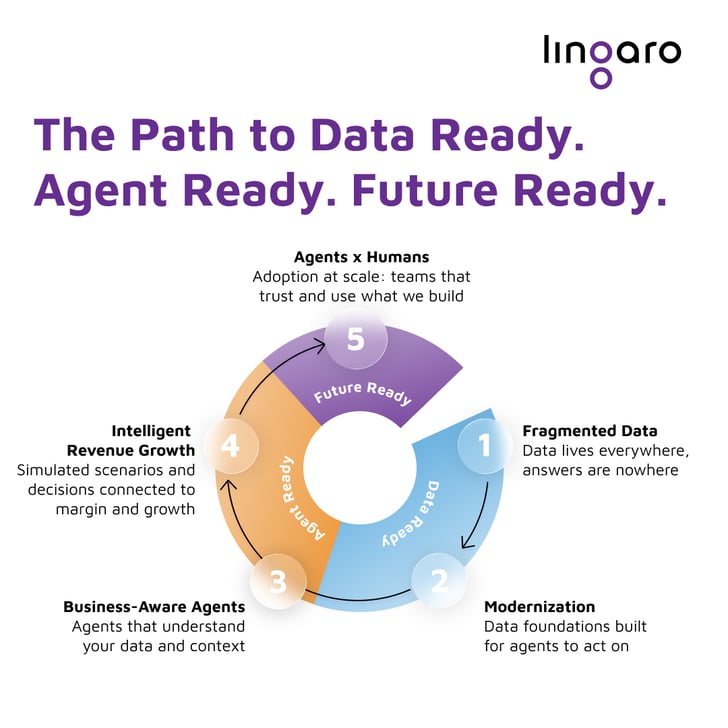
Data Ready. Agent Ready. Future Ready
The future of the enterprise is hybrid, with humans and agents working side by side. To succeed, organizations need more than AI tools. They need trusted data, business context, and a clear path from insight to action.
Lingaro brings these elements together through an end-to-end approach spanning data modernization, contextual AI, intelligent decision-making, and adoption. We help you turn fragmented data into measurable business value, so your organization becomes Data Ready. Agent Ready. Future Ready.
FAQs
What makes a data platform "AI-ready"?
A semantic layer, catalog-level governance, machine-readable lineage, and owned data products with quality contracts. If an agent cannot resolve a business question to a governed asset without human interpretation, the platform is not AI-ready.
What causes data migrations to overrun?
Undocumented legacy logic and validation deferred until the end, when little schedule contingency remains.
How do we estimate a migration without guessing?
Model effort from procedural complexity, dependency depth, source count, quality debt and ownership, rather than object counts.
Data migration versus data modernization?
Migration changes where data runs. Modernization changes what it can be used for. Without a target architecture, migration reproduces the old estate on newer infrastructure.