


.png?width=725&height=725&name=2097%20Blog%20Cover_%20Awareness%20Article%20221225%2012-(Compressify.io).png)
.jpg?width=750&height=240&name=2097%20Blog%20Cover_%20Awareness%20Article%20221225%2011-(Compressify.io).jpg)
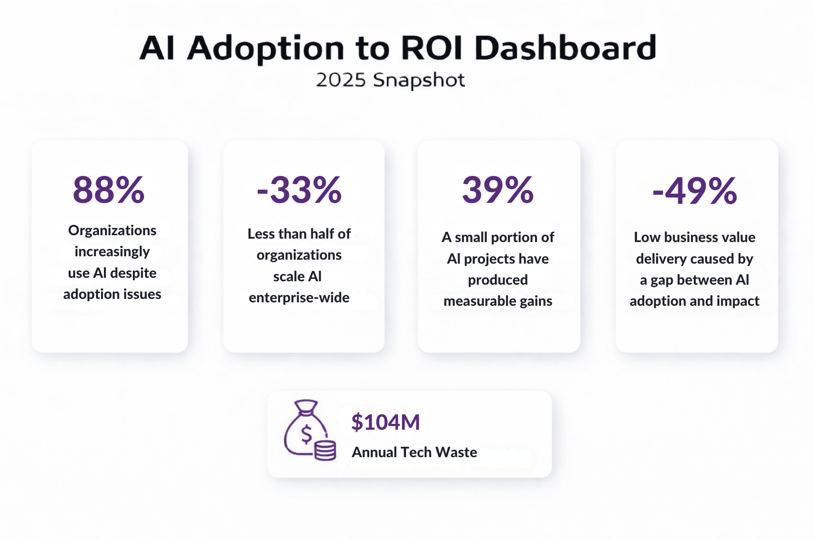
The time for pilots is over; experimentation isn’t enough anymore. It’s all about AI adoption ROI. 2025 marked a turning point: nearly 88% of organizations are using AI, yet only about one-third have scaled it enterprise-wide, and just 39% report EBIT impact, highlighting a stark divide between adoption and measurable value.
AI adoption isn’t about buying tools; it’s about driving measurable ROI through strategy. Companies that align AI initiatives with business goals, prepare people for change, and embed usage into workflows move faster from pilots to impact.
Yet many organizations learned this the hard way. After investing in AI licenses, leaders were left asking, "I have a copilot license; what now? Once pilots go live, pressure mounts to show the value of their generative AI adoption. Unfortunately, without a clear AI adoption strategy, most initiatives stall.

Hype vs. Reality
The GenAI gold rush may be over, but return on investment (ROI), cost savings, and productivity gains haven’t vanished. They’ve become more critical than ever to achieve, even as they become increasingly elusive. Boards and CFOs now demand clear returns.
McKinsey’s 2025 State of AI report is clear. While 62% of organizations are experimenting with AI agents, nearly two-thirds are still only in pilot stages. Even with broad adoption, few companies embed AI into workflows deeply enough to drive enterprise-level value.
Why ROI Is Hard
Most companies invested early in AI-powered initiatives, yet few converted that investment into measurable business value. McKinsey reports that while 65% of organizations adopted GenAI, only 23% achieved large-scale revenue impact, underscoring the gap between adoption and ROI.
Adoption alone doesn’t guarantee returns. WalkMe’s 2025 report shows enterprises waste $104 million annually on underused tech, with 75% of employees struggling to use available tools effectively.
This gap defines today’s reality. AI presence is common. AI returns are rare.
What Leaders Must Do Next
For Directors, this changes the job. Success is no longer defined by experimentation, technical delivery, or model performance. Proven impact of AI on business processes defines success. If an MVP does not show impact, there is no rollout. No scale. No budget extension.
At this stage, picking the right AI use case for your industry, function, and teams is essential. So is the discipline to test, learn, and adjust until value is visible. AI programs now succeed or fail based on adoption and usage economics. It is not technical ambition or being AI driven in name only.
This is the turning point. The winners move from building AI to integrating AI into daily work.
The Reality Check: Go-Live doesn’t equal Success
Many AI initiatives fail. They go live on time, stay within scope, and still destroy value. The reason is simple. ROI does not come from deployment. ROI comes from people changing how they work.
When adoption is low, even the best GenAI solution becomes a lost investment. It won't save time or improve customer service. Many learn this the hard way. For example, a Fortune 500 company launched a GenAI copilot. They had strong executive support and major investment. Even so, the result was predictable. Limited productivity gains. No material business impact. Most of the investment never paid back.
Nothing was wrong. The failure was strategic. The plan never embedded end users. People treated adoption as a downstream activity. They should have been treating it like a part of their AI strategy core design. This is the financial risk many leaders fail to appreciate. AI economics rely on scale of use. Businesses incur fixed costs upfront. Benefits appear only when enough people use the tool.
This leads to a question every Director should ask themselves: What percentage of your workforce must use this tool for it to pay off. In most enterprise scenarios, the number is high. When value depends on many roles improving productivity, adoption becomes a mathematical need. If usage stays low, ROI is often impossible.
At this stage of the market, adoption is not a nice to have. It is the condition for survival. Going live means costs become permanent. That is, unless you have a clear plan for integrating AI into the right roles.
The Solution: A Structured Path from Adoption to ROI
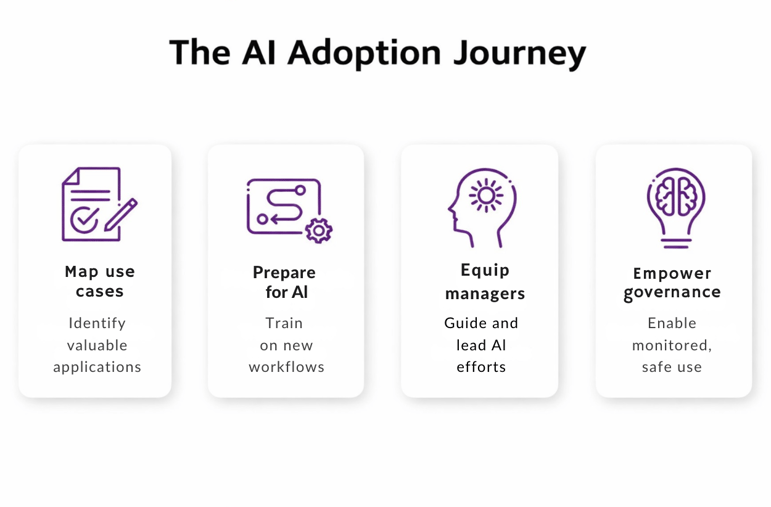
The organizations that move from AI to ROI share one trait: they treat adoption as a design discipline, not a rollout task. Adoption starts long before going live.
Four practical shifts make the difference:
- Map Use Cases, Don’t Just Align: Find the top three problem areas in your supply chain or marketing workflows, like SKU cleanup or localizing campaigns, and use AI to fix those specific issues. If the tool doesn’t solve a real problem, don’t use it.
- Prepare People, Not Only Platforms: Train them for workflows, not just features. Show employees how AI changes their daily tasks and KPIs. Adoption fails when training is generic or too late.
- Governance That Empowers: Adoption slows when people worry about breaking rules. Set up Sandbox Zones where teams can try and fail without risk. Build clear data rules right into the tools — not hidden in long policy documents. When people trust the safety features, they work faster and with confidence.
- Equip Managers With a 'Team Adoption Scorecard: Instead of vague encouragement, provide them with metrics on their team's usage intensity vs. output quality. Shift the KPI from 'number of logins' to 'hours saved per task'. Managers cannot drive behavior change without the data to measure it."
Conclusion: Turning Planning into Impact
Turning GenAI into measurable ROI does not demand complexity. Results come from disciplined planning and collaboration across business and technology teams. Adoption processes are not soft activities. Adoption converts investment into value.
Organizations see impact when AI tools integrate into daily work from the start. This means clear ownership, role level readiness, and shared expectations before going live. When leaders design for usage early, adoption scales. When adoption scales, returns follow.
The next step is understanding how successful teams plan for adoption before launch. Leaders who treat adoption as a design decision, not a rollout task, move faster from pilots to impact.
Your ambition is to lead with AI. To succeed at scale, technology, governance, and people must work together as one. Lingaro partners with global enterprises to design adoption strategies that deliver ROI; helping leaders move from pilots to impact. Lingaro delivers up to 5x faster adoption thanks to 7 Pre-built accelerators. You can discover them in our case studies which will be released shortly!
Our delivery model offers The Triple Advantage:
- Velocity – fast results through agile use case delivery
- Trust – strong foundations with robust governance
- Adoption – lasting impact through people-first talent management
We don’t just deliver projects; we build a scalable AI capability that drives real business results.
.jpg?width=1400&height=800&name=2103%20Graphics%20for%20Awareness%20Article%20221226%203-(Compressify.io).jpg)




.png?width=528&height=313&name=1546%20Blog%20Covers%2c%20Article%20From%20the%20Business%20Insider%20old2-(Compressify.io).png)