


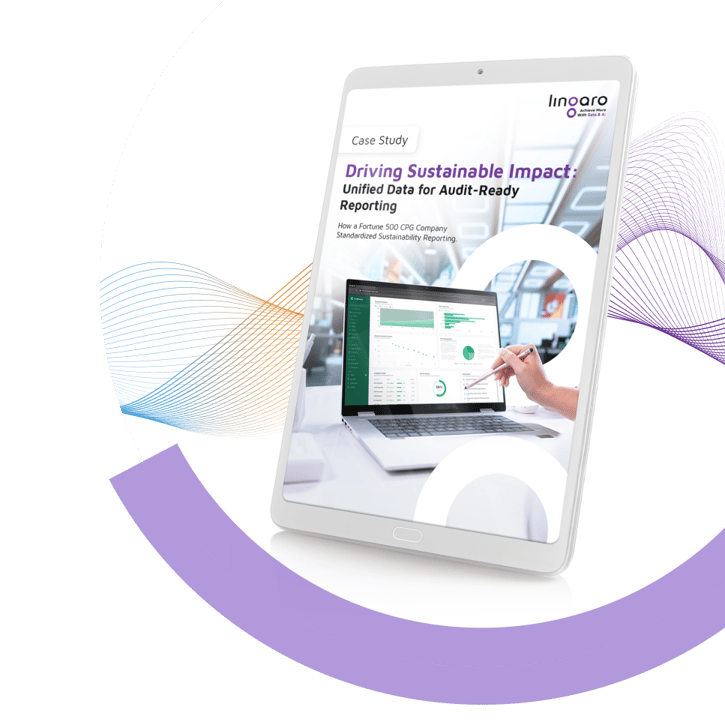

A Fortune 500 CPG company strengthened sustainability reporting with Lingaro’s Sustainability Reporting Hub, a governed data lake and dashboard layer that unified fragmented data and enabled audit-ready disclosures.
Client Profile:
Lingaro partnered with a global CPG leader and Fortune 500 company operating across multiple regions under complex, evolving regulatory requirements.
Challenge:
The client faced rising pressure to deliver accurate, auditable sustainability disclosures across CSRD, ESRS, CDP, GRI, SASB, and EPR. Reporting relied on fragmented spreadsheets and SaaS tools, which created inconsistent data and low trust. Teams duplicated work across frameworks and spent significant time reconciling inputs. Audit readiness depended on manual explanations instead of system-backed traceability. The organization needed a centralized sustainability data foundation to ensure consistency, ownership, and compliance at scale.
Solution:
The Sustainability Reporting Hub is a unified data platform for compliance, assurance, and executive insight. Lingaro replaced spreadsheet-based processes with a governed data lake and standardized mappings, enabling one dataset to support CSRD, GRI, CDP, SASB, EPR, and local requirements.
-
Centralized data lake with preserved raw data, full lineage, and audit trail.
-
Standardized processing applied once and reused across multiple frameworks.
-
Governed workflows with defined ownership, approvals, and change tracking.
-
Executive dashboards with KPIs, trends, and disclosure-ready outputs.
-
Integration with SAP, Oracle, Workday, and external data sources.
Impact:
The solution replaced fragmented sustainability data flows with a centralized governed data lake and executive dashboards, improving transparency, control, and reporting speed.
-
Audit-ready traceability from source data to disclosure.
-
Clear visibility into sustainability performance across regions and brands.
-
Higher confidence in data through standardized governance and ownership.
-
Reduced compliance risk with structured workflows and full audit trails.
-
Faster reporting cycles with consistent regulator-ready outputs.
-
200 plus data points per standard, 20 plus jurisdictions, 75 percent less reporting preparation time, 60 percent less manual data entry.
This transformation turned sustainability reporting from a fragmented compliance task into a scalable, governed capability. The organization now operates with consistent, trusted data across frameworks, enabling faster reporting and stronger control at enterprise scale.
Download Full Case Study


%20article%20%E2%80%93%20blog%20coversdesktop.jpg?width=528&height=313&name=2298%20Life%20Cycle%20Assessment%20(LCA)%20article%20%E2%80%93%20blog%20coversdesktop.jpg)