


%20article%20%E2%80%93%20blog%20covers.png?width=725&height=725&name=2298%20Life%20Cycle%20Assessment%20(LCA)%20article%20%E2%80%93%20blog%20covers.png)
%20article%20%E2%80%93%20blog%20coversmobile.jpg?width=750&height=240&name=2298%20Life%20Cycle%20Assessment%20(LCA)%20article%20%E2%80%93%20blog%20coversmobile.jpg)
Understanding environmental impacts is imperative for managing them and communicating progress to consumers. Consumer Packaged Goods (CPG) companies have so far focused on company-wide reporting obligations, not product sustainability.
With only a company-wide understanding, CPG leaders can’t pinpoint which products drive impacts across thousands of SKUs. You must understand product impacts to tailor initiatives and communicate product sustainability information to stakeholders.
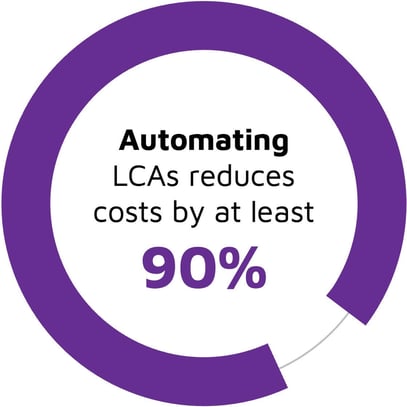
Life Cycle Assessment, the gold standard for product sustainability measurement is slow and costly to deploy across large SKU portfolios. Automating LCAs reduces costs by at least 90%, enabling large-scale deployment of LCAs across even the largest portfolios.
Corporate sustainability reporting is how corporate environmental impacts are measured today
Corporate sustainability reporting has expanded over the past two decades. The UN's 2015 Paris Agreement sped up this shift. It culminated in the early 2020s era of emerging Net Zero 2050 commitments and pledges. To reach Net Zero, companies needed to first understand how much net-negative they were. What was their carbon footprint?
The GHG Protocol’s standard, published in 2001, gave companies a clear way to measure their climate impact, covering both direct operations and the full value chain. It underpins Corporate Carbon Footprints (CCF) which became a priority for corporations.
CCFs answer key questions for external stakeholders such as regulators, investors and business partners on corporate climate impacts. They became integrated into larger reporting frameworks and standards such as SASB, GRI, and CSRD. These frameworks gave companies tools to report their carbon footprint and other environmental impacts, such as water use.
Corporate sustainability reporting is necessary but insufficient
Sustainability reporting utilizing CCFs and equal methods for other environmental impacts has one critical limitation. It aggregates impacts to company level data. Such aggregates are good for many uses and stakeholders but insufficient for important uses such as:
In both B2C and B2B, buyers want to understand the sustainability of the specific product they buy. They do not want to rely only on how sustainable the seller appears in total. To check product sustainability, companies need product level data. They also need it to benchmark alternatives.
Realizing sustainability ambitions through impact reductions
For initiatives aimed at improving sustainability performance to be effective both the before and after need to be measurable. Without enough detailed data it’s impossible to identify hotspots and target initiatives. Sustainability reporting shows that energy use at a specific factory may be a problem. It does not show which products drive that energy consumption.
With a strong focus on products, Life Cycle Assessments were the answer all along
Life Cycle Assessment is a standardized method for product sustainability characterized by:
- Evaluating the entire product lifecycle and breaking it down by life-cycle stage (e.g. manufacturing, use etc.)
- Covering multiple environmental impacts, not being limited to “carbon only” (e.g. water, land use etc.)
LCAs are perfect for evaluating product sustainability, identifying hotspots and improvement areas and communicating it to stakeholders. LCA predates corporate carbon accounting, with the first ISO standard in 1997. Since then, it has become the go-to method for product sustainability.
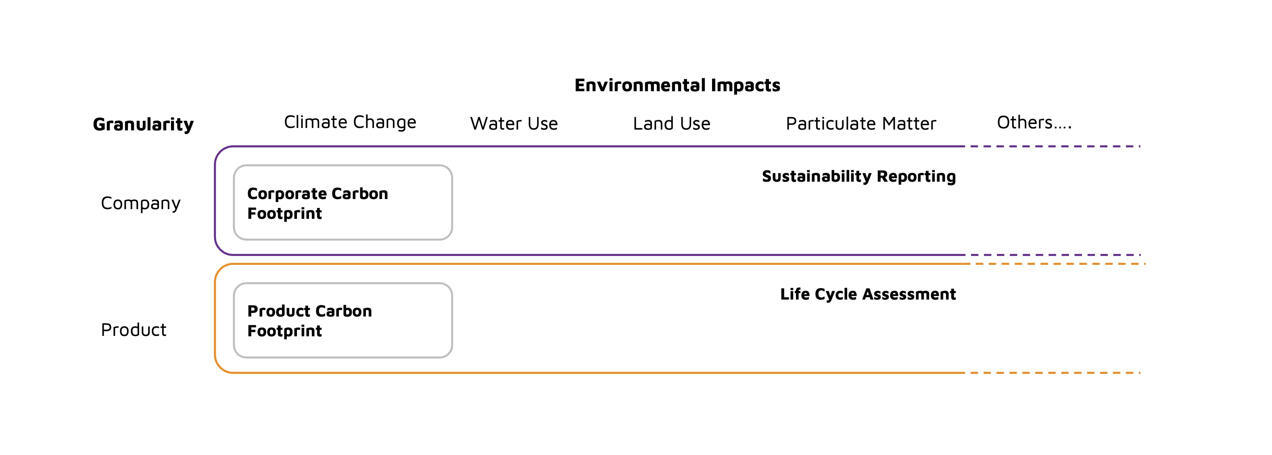
See the graph below to understand how LCAs map against other methods and standards. LCAs serve products in the same way sustainability reporting serves companies.
Environmental impact data coverage by method:
Despite its advantages, LCA adoption remains limited
LCAs face three key challenges that limit their widespread adoption. These challenges restrict both which companies use them and how many products they apply them to.
High Costs-
The cost of a proper LCA study starts at $10,000. For large corporations and complex products, it can exceed $50,000 per product. This approach works in some industries. It fits companies with small, standardized, and stable product portfolios.
-
Most consumer companies, however, manage large amounts of products and change their portfolio regularly. To assess over 80% of those products with traditional LCA studies, our clients would need to spend over $60 million annually. Those studies would become outdated within one to two years.
Long Turnaround
-
LCA studies require approximately three to six months. Manual data collection and modeling slow the process. At best, teams complete one LCA study per quarter.
-
Organizations with in-house LCA experts and ready data can shorten this timeline to two to three months, assuming no backlogs exist. In practice, that situation is rare.
-
This process creates uncertainty for decision makers because results often arrive after they have already made the relevant decision. Iteration of initiatives and experimentation becomes impractical, as a full cycle can take years.
Scarce Primary Data
-
LCA standards require a share of primary data in their calculations, not only data from databases with industry average numbers.
-
Gathering this data for internal operations is tiresome but workable. The challenge begins when companies must collect information from suppliers about purchased components.
This is particularly challenging for the consumer goods industry. Companies in this sector operate large and complex supply chains. Suppliers beyond Tier 1 (direct suppliers) may be unknown, making it difficult to receive data from them. In addition, suppliers need their own tools and LCA expertise to produce qualifying data. For these reasons, most industries have not yet fully utilized the potential of LCAs.
Some industries stand apart. Certain heavy industries have led with intensive use of LCAs. Parts of the construction sector, especially in the EU, have done the same. They have also adopted Electronic Product Declarations based on LCA methods.
These industries and companies are the least affected by these three challenges. Cement manufacturers change processes less often and operate shorter supply chains. They also tend to manage fewer products than a typical consumer company has brands.
For CPG, demand for LCA studies increasingly exceeds supply
As outlined, being able to understand an entire product portfolio through LCAs already brings immense benefits. This trend will only increase as pressure mounts. Digital Product Passports in the EU are approaching, and each new generation is more sustainability conscious. The leaders of tomorrow will be those who embrace LCAs today.
Looking at past trends and our discussions with clients, we see a clear pattern. This is how environmental impact measurement maturity is evolving for consumer companies.
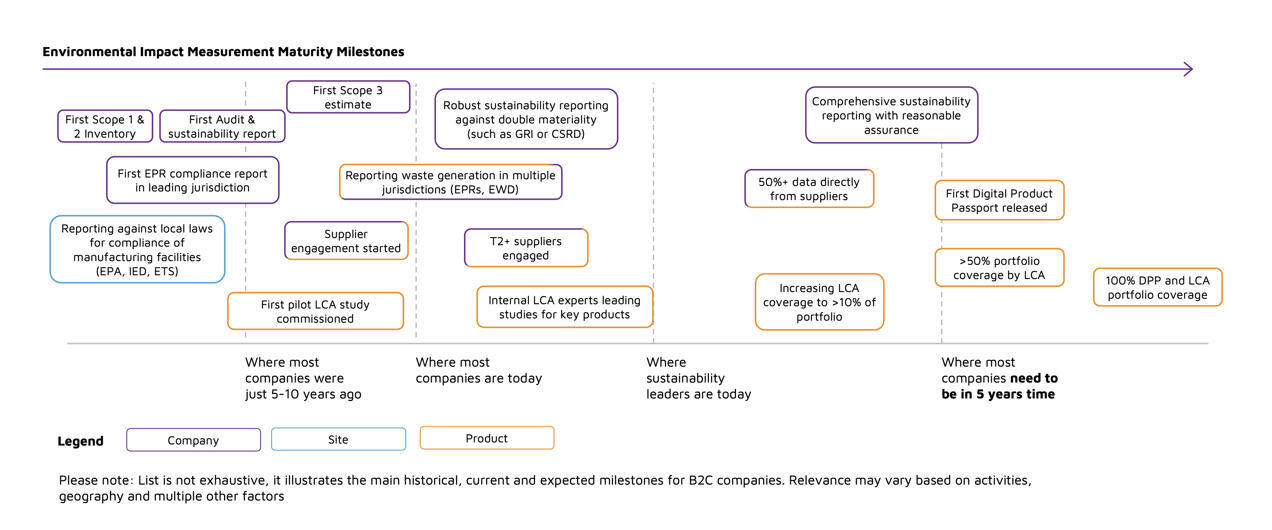
Lingaro analyzes measurements by data type as per our Sustainability Data Matrix. Our assessment suggests that product sustainability data will only become more notable. This poses a question, how to improve adoption of LCAs given their challenges?"
For most of the consumer industry, automation is the only way forward
As many times, in human history, to improve productivity, we had to resort to automation. From simple watermills, through complex industrial machines and recently through digital solutions. LCAs must undergo an industrial revolution of their own: going from an artisanal product to a mass produced good.
The digital age gives us the tools to achieve this. Digital data integration allows us to automate most of an LCA study and conduct it at scale, almost instantly. From an automation point of view, we divide an LCA study into four key components.
|
LCA Study Component |
Traditional Manual LCA Study |
Automated LCA Solution |
|
Modeling Determines scope and types of data required |
Done by LCA practitioner in dedicated software for a specific study |
Large LCI library models builtby LCA practitioners on a per product group basis |
|
Product Data Contains details on components and material information such as product use |
Gathered manually from company records for a specific study |
Data pipeline from ERPs for data such as BoMs into a central LCA data lake |
|
Environmental Data Consists of impact factors translating product into environmental data |
Gathered manually or through software by LCA practitioner for a specific study |
Data pipeline from LCA software, company databases, or direct supplier data into a central LCA data lake |
|
Report Creation Final report detailing the study results, may be for external declarations or verification |
LCA practitioner manually compiles study results for internal analysis or external declarations |
Dedicated application automatically compiles reports ready for review |
How Lingaro scales automated LCA across your portfolio
Traditional LCA studies are expensive, slow, and difficult to scale across large product portfolios. Lingaro helps enterprises deploy Automated Life Cycle Assessment across their entire product range.
We combine two core capabilities:
- Advanced data integration expertise to automate the collection and management of any data source.
- A dedicated Sustainability Practice with LCA consultants experienced in automation-ready modeling.
Lingaro stays technology agnostic and builds a centralized LCA data lake within your existing infrastructure in Azure, AWS, or Databricks.
Your product data remains in-house and under your control. This architecture removes the two main adoption bottlenecks: excessive costs and turnaround. It also helps alleviate the third: scarce primary data.
Cost
- Automation can bring down the cost of LCAs by over 90%
- Less than $50 per SKU for partial or simple products (such as packaging only)
- Under $200 per SKU for holistic LCA for typical consumer goods
Time
- Instant calculations with LCAs available in real time as portfolios change.
- Analytics modules can effectively eliminate wait times: with simulations available instantly in dedicated solutions
- Near-zero cost of simulations enabling efficient R&D
Primary data
- Streamlining data collection and processing through automated pipelines enables smooth ingestion into LCA tools
- Dedicated optional supplier data collection platforms help collect and structure supplier data
With this approach, full portfolio LCA coverage becomes practical and repeatable. See how Lingaro can help your organization move from isolated studies to continuous product level insight.
FAQ
What is life cycle assessment LCA?
Life cycle assessment (LCA) is a methodology to measure product or service environmental impacts. LCA can measure the entire product life cycle, so called “cradle to grave” scope.
What does an LCA study include?
An LCA study defines the goal and scope, gathers input and output data in the life cycle inventory, and translates that data into standardized impact metrics through impact assessment. The final stage interprets the results, often followed by third party verification to confirm validity.
What do LCAs measure beyond carbon?
LCA measure the climate impacts through CO2e and metrics such as water use, land use, and even human toxicity. According to PEF Framework 16 separate categories (impacts) are to be considered.
How does LCA influence product design decisions?
LCA supports Ecodesign of new products by enabling identification of impact “hotspots” and evaluating the potential impacts a material or component change brings.
How is LCA different from a corporate carbon footprint?
A corporate carbon footprint measures company-wide emissions. LCA assesses the impacts of a specific product or service across its entire life cycle.



%20article%20%E2%80%93%20blog%20coversdesktop.jpg?width=528&height=313&name=2298%20Life%20Cycle%20Assessment%20(LCA)%20article%20%E2%80%93%20blog%20coversdesktop.jpg)