


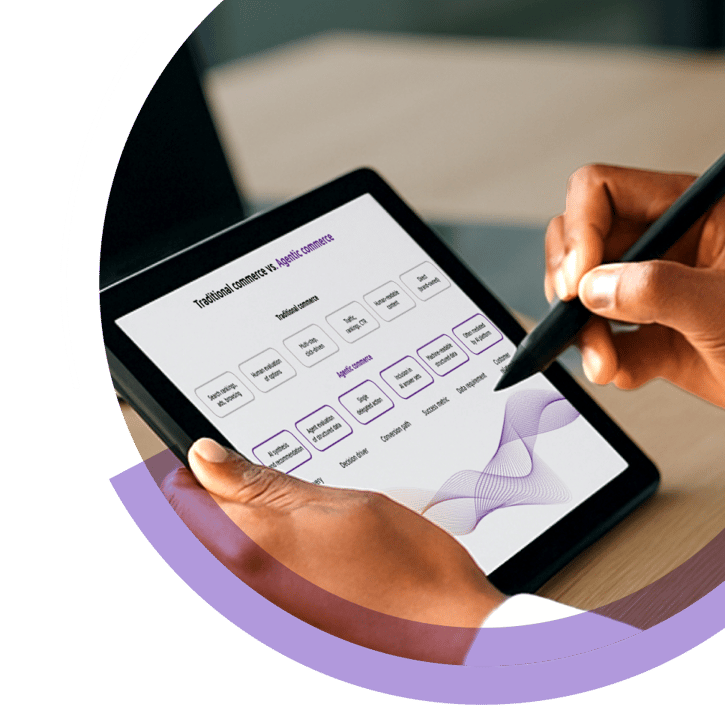

Agentic commerce is a buying model where AI manages the entire process, interpreting intent, comparing options, building baskets, and completing purchases for consumers and businesses. Instead of browsing websites, buyers rely on AI agents that handle discovery, decision, and execution across platforms like ChatGPT, Google AI Mode, and Perplexity. In many cases, the outcome is decided before a brand site is ever visited.
This fundamentally changes how brands compete. In traditional commerce, success depended on traffic and conversion. In agentic commerce, AI systems decide:
- What products are included
- Which options meet the criteria
- Whether a purchase can be executed
If your systems cannot provide clear, consistent, and machine-readable answers, your product is excluded. The result is a new risk: silent revenue loss. Demand still exists, but products never enter the buying journey.
This shift is already visible across DTC and B2B environments. Consumers use AI to research and buy faster, while procurement teams automate sourcing, enforce contracts, and trigger reorders. Buying is becoming system-driven, not user-driven.
Most organizations are not blocked by AI itself, but by readiness gaps, including:
- Fragmented product and content data
- Inconsistent signals across channels
- Misaligned pricing, inventory, and checkout
- Limited visibility into AI-driven decisions
These issues prevent AI from confidently including and executing your offer.
The solution is to focus on three pillars:
- Be Discoverable: ensure product data is structured, consistent, and trusted
- Be Transactable: align pricing, availability, and checkout for clear execution
- Own the Experience: retain control of data, decision logic, and relationships
Start with one real buying journey. Identify where inclusion fails, execution breaks, or control is lost. Fix that constraint first, then scale. Interested to learn more?