Artificial intelligence (AI) and machine learning (ML) are moving from experimental pilots to enterprise capabilities that improve decisions, automate work, and create measurable business value. To scale successfully, organizations need more than models. They need trusted data foundations, clear use cases, production-ready engineering, responsible governance, adoption support, and ongoing optimization. Lingaro supports this full lifecycle through AI advisory, data readiness, AI/ML solution design, MLOps, Generative AI, intelligent automation, analytics, and managed services.
Key Summary
-
AI and ML help enterprises move from reactive reporting to predictive and automated decision-making.
-
AI and ML services work best when they connect strategy, data readiness, solution engineering, adoption, and support.
-
ML solutions need strong data quality, scalable architecture, and clear business KPIs to create lasting value.
-
AI consulting services help organizations identify use cases, prioritize investments, and build responsible AI roadmaps.
-
MLOps and AI support turn models into governed, monitored, cost-effective, production-ready capabilities.
Why AI and Machine Learning Matter Now
Enterprises are under pressure to make faster decisions, improve productivity, personalize experiences, and uncover value hidden in complex data. That is why artificial intelligence and machine learning have become central to digital transformation. They help organizations forecast demand, detect anomalies, automate recommendations, summarize knowledge, optimize operations, and support teams with intelligent assistants.
However, AI success is not only about choosing an algorithm or launching a chatbot. Many organizations struggle to move from proof of concept to enterprise adoption because their data is fragmented, governance is unclear, model ownership is weak, or users do not trust the output. A mature approach connects technology with business priorities, domain expertise, human-centered design, and adoption support.
What an Enterprise AI and ML Offering Should Include
A complete AI and ML services offering should cover the full lifecycle, from strategy to production and continuous improvement. It starts with use case discovery, where business and technical teams identify the problems AI can realistically solve. These use cases should be assessed for value, feasibility, data availability, compliance needs, cost, and adoption potential.
Next comes data readiness. Reliable AI depends on accurate, accessible, governed, and well-structured data. This often involves data profiling, quality frameworks, enrichment at ingestion, architecture decisions, and measurement frameworks that connect AI outputs to business KPIs. Without this foundation, models may perform well in isolated tests but fail in real operating conditions.
The delivery stage includes solution architecture, model development, integration, testing, deployment, and productization. This is where machine learning solutions become embedded into workflows, dashboards, applications, copilots, or automated decision systems. For enterprise environments, delivery also requires security, compliance, monitoring, explainability, and cost control.
From Use Case Discovery to Production AI
Many organizations begin with AI experimentation, but enterprise value comes from disciplined execution. A strong operating model moves through clear stages: use case hunting, proof of concept, MVP, industrialization, scaling, and ongoing support. Each stage should answer a different question. Is the use case valuable? Is the data ready? Can the model perform reliably? Can it be integrated into the business process? Can users adopt it? Can the organization maintain and improve it over time?
This lifecycle matters because AI projects often fail when they are treated as one-off technical builds. Teams may develop an accurate model, but if it is not supported by the right infrastructure, governance, monitoring, and adoption plan, it will not become a sustainable business capability. Enterprise AI should be designed to live inside real workflows, not outside them.
Where AI and Machine Learning Create Business Value
AI and ML can support a wide range of business functions. In commercial analytics, they can help teams improve pricing, promotion effectiveness, customer segmentation, sales recommendations, and revenue growth decisions. In supply chain, they can support demand sensing, forecasting, inventory optimization, route planning, and logistics decisions. In manufacturing, they can detect quality issues, optimize production, and support predictive maintenance.
Generative AI expands the opportunity further. Enterprise assistants can search across SharePoint files, databases, PDFs, presentations, and reports to answer business questions in natural language. Conversational AI can help employees, customers, or partners access knowledge faster. Content generation, intelligent summarization, document processing, AI-powered learning, and automated translation can reduce manual work and improve productivity.
The key is to prioritize use cases where AI can change decisions or reduce operational friction. The strongest opportunities usually combine clear pain points, reliable data, measurable outcomes, and a workflow where users can act on AI-generated recommendations.
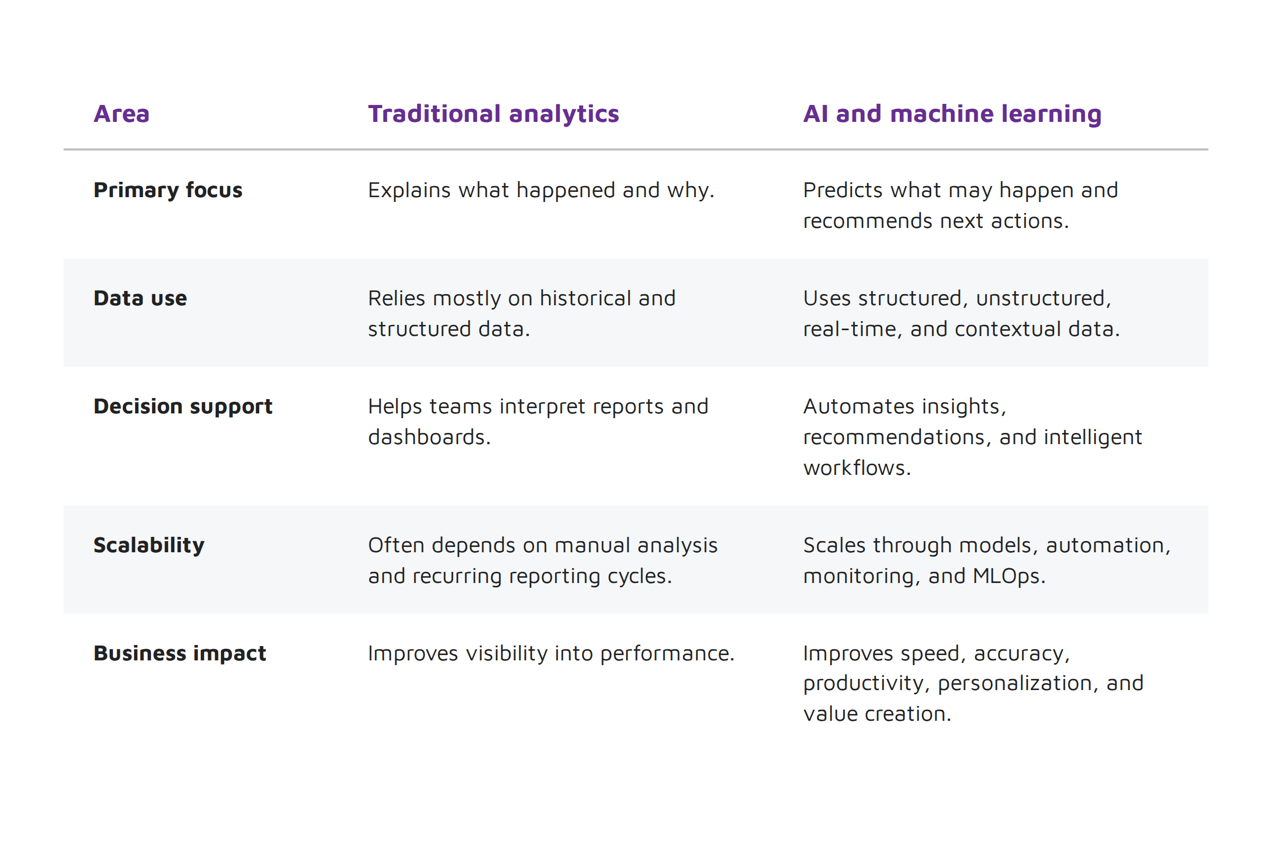
Traditional Analytics vs. AI and Machine Learning
Why MLOps and Ongoing Support Are Critical
Production AI needs more than model deployment. It requires MLOps and AI support to manage pipelines, monitor performance, control costs, retrain models, track data drift, govern access, document changes, and keep solutions aligned with business needs. This is especially important when AI is used across multiple markets, functions, or business units.
MLOps also improves delivery speed and quality. Reusable templates, standardized pipelines, model registries, testing frameworks, and automation help teams avoid rebuilding the same foundations for every project. They allow data scientists to focus on business logic and model performance while engineering, governance, and operational standards are handled consistently.
Responsible AI and Governance
As organizations scale AI, responsible governance becomes essential. Teams need clarity on transparency, human oversight, data privacy, explainability, model validation, and regulatory readiness. Responsible AI is not a brake on innovation. It is the foundation that helps businesses use AI with confidence, reduce risk, and build trust among employees, customers, and regulators.
Governance should be built into AI strategy, solution design, implementation, and operations. This includes risk assessments, clear ownership, monitoring, escalation paths, and guidelines for human review. For Generative AI, governance also includes prompt management, retrieval quality, hallucination controls, source traceability, content validation, and ongoing model evaluation.
How Lingaro Can Help
Lingaro helps enterprises turn AI ambition into measurable business impact by combining data expertise, AI engineering, domain knowledge, design, adoption, and ongoing support. Its Data Science and AI services cover the full lifecycle, from use case identification and advisory support to PoC, MVP, production deployment, scaling, and maintenance.
Lingaro supports AI consulting services, AI-ready data flows, technology advisory, solution architecture, ML productization, GenAI implementation, conversational AI, computer vision, natural language processing, forecasting, optimization, and intelligent automation. Its teams include AI advisors, data scientists, AI architects, AI engineers, and MLOps specialists who combine technical expertise with business acumen.
For organizations looking to scale AI responsibly, Lingaro helps establish strong foundations: data readiness, governance frameworks, AI adoption programs, model operations, monitoring, and value measurement. Its support also extends across major technology ecosystems, including Microsoft, Databricks, Snowflake, and other cloud and data platforms.
What makes the approach practical is its focus on business outcomes. Lingaro does not treat AI as a standalone technology layer. It helps organizations connect AI to commercial growth, supply chain resilience, manufacturing efficiency, sustainability, employee productivity, customer engagement, and faster decision-making.
FAQs
What are artificial intelligence and machine learning?
AI enables systems to perform intelligent tasks, while machine learning helps systems improve from data.