Enterprise AI often fails not because data is missing, but because meaning is. AI agents can retrieve information, summarize documents, and generate answers, but they still struggle when they do not understand the business definitions, relationships, rules, and evidence behind the data. Lingaro’s Contextual AI Factory gives AI that reusable business context, helping organizations move from isolated pilots to more reliable, explainable, and scalable enterprise AI.
Key takeaways
-
Data access is not the same as business understanding. AI needs shared definitions, relationships, rules, ownership, and source context to interpret information correctly.
-
A context layer for AI agents helps connect business meaning to the data, documents, systems, and decisions agents use to answer questions or take action.
-
A semantic layer for AI helps standardize business metrics and calculations, while a Contextual AI Factory goes further by capturing broader meaning, relationships, rules, and reasoning.
-
As Copilot, agents, and enterprise AI move from answering questions to supporting decisions and workflows, governed business context becomes essential infrastructure.
AI can reach the data. That does not mean it understands it.
Many organizations are discovering that access to data does not automatically produce trusted AI outcomes. AI can retrieve information, summarize documents, and generate answers, but it often struggles with the business definitions, relationships, ownership, decision logic, and organizational knowledge behind the data.
The result is inconsistent answers, low trust, extensive human validation, and pilots that never scale. The problem becomes more urgent as AI agents start to do more than retrieve information. When agents recommend actions, trigger workflows, or support decision-making, missing context can become an operational risk.
Lingaro helps organizations build the governed business context AI needs to interpret enterprise data correctly, explain its answers, and scale beyond isolated pilots.
Why business context is becoming enterprise AI infrastructure
Business context is becoming part of enterprise AI infrastructure. RAG helps retrieve relevant unstructured information. A semantic layer helps standardize business metrics, definitions, and calculations.
But AI agents also need a broader model of what business concepts mean, how they relate, which rules apply, and which source should support an answer. This is where an ontology for enterprise AI, understood simply as a shared model of business concepts and relationships, makes enterprise meaning explicit.
RAG, semantic layers, ontologies, and knowledge graphs are not competing approaches. They solve different problems and become stronger when they work together. A clear context layer for AI agents connects them into a governed foundation that helps agents interpret questions, choose the right sources, apply rules, and return answers that teams can verify.
That matters now because enterprise AI is moving from simple question answering to agentic workflows. Copilot-style assistants and AI agents need more than retrieved documents. They need governed business meaning, traceable logic, and clear constraints so they can support decisions safely and consistently.
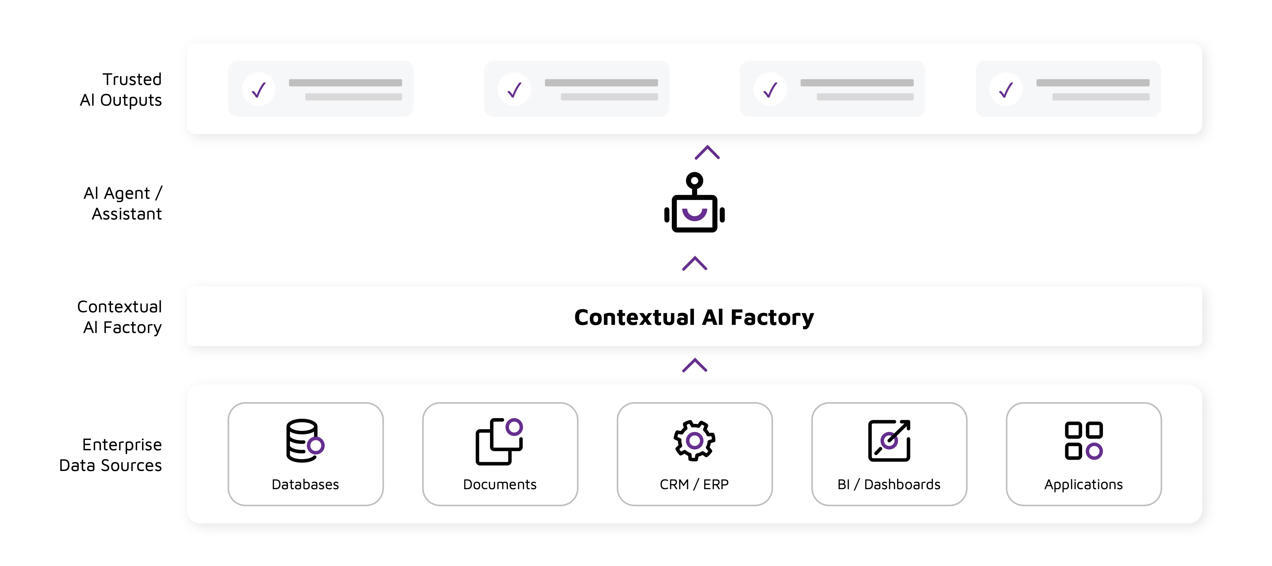
The graphic below shows the idea in simple terms: enterprise sources feed a reusable context layer, which gives AI agents the business meaning they need to produce trusted answers.
Here are five signs that missing business context may be what is holding your AI initiatives back:
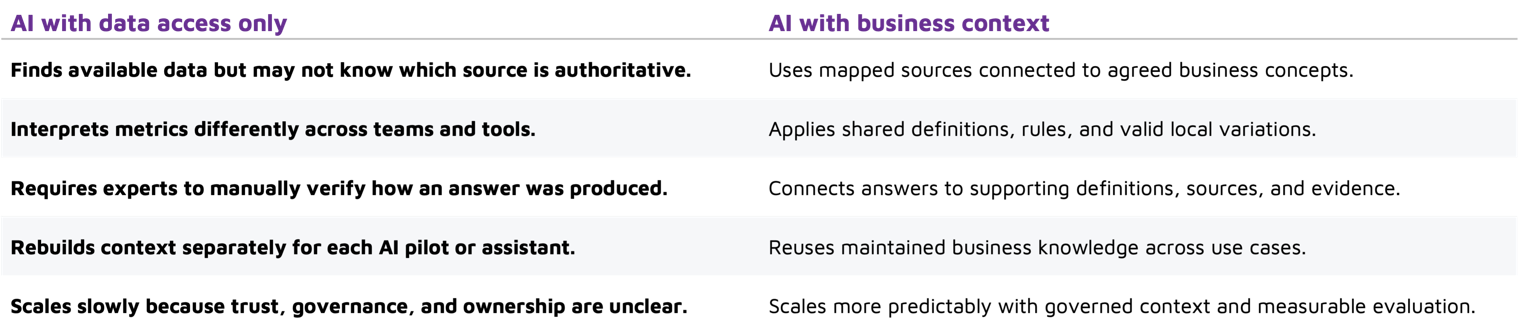
Sign 1: Different teams get different answers from the same system
Two teams can ask the same AI assistant about revenue and receive different answers. Both may look reasonable, but each may rely on different definitions, source tables, filters, or time windows.
When definitions live across dashboards, models, spreadsheets, documents, and expert knowledge, AI may choose accessible data over appropriate data. A semantic layer for AI can reduce ambiguity around metrics and calculations, while the Contextual AI Factory connects those definitions to broader relationships, rules, ownership, and source context.
Sign 2: Experts constantly need to validate AI outputs
If every AI-generated answer needs an expert to check it, the organization has not scaled intelligence. It has scaled review work.
This usually happens when outputs cannot be traced to the definitions, rules, and sources used to produce them. Contextual AI makes validation easier by linking answers to agreed terms, source mappings, business rules, evidence, and the reasoning path behind the result.
Sign 3: AI struggles when questions span multiple systems
Many business questions span CRM, pricing, finance, supply chain, customer hierarchy, documents, and BI models. An AI agent may access each source individually and still fail to understand how the pieces connect.
Business context must show how information fits together across systems, documents, and expert knowledge. It should also guide which source is authoritative for each question, and which relationships or constraints matter for the answer.
In complex environments, a knowledge graph for AI agents can help represent business entities and relationships, so AI understands how customers, accounts, products, policies, and profitability connect.
Sign 4: Every AI use case starts from scratch
Another warning sign is duplicated effort. Each project teaches AI about the business through prompts, custom integrations, one-off pipelines, or local SME knowledge, but that knowledge often stays trapped in the project.
A reusable context layer changes the pattern: definitions, source mappings, rules, relationships, evidence, and ownership can be maintained once and reused across agents, analytics, and applications.
Sign 5: Pilot success never becomes enterprise scale
AI pilots often succeed because they are carefully bounded. The data is selected, the use case is narrow, experts are close to the project, and exceptions are handled manually.
Scaling requires context, evaluation, ownership, and governance that can be maintained as definitions evolve; systems change, and new use cases are added. Without that foundation, organizations repeat the same cycle: promising pilot, heavy manual support, limited trust, and slow rollout.
What contextual AI changes
Contextual AI organizes business knowledge so AI agents, analytics, and applications can use it consistently. For many organizations, this becomes an enterprise context layer: a maintained foundation of definitions, relationships, rules, source mappings, ownership, and evidence that AI can use in production.
For example, it establishes what customer, available inventory, profitable product, high-value account, or resolved enquiry means; where the information lives; how it should be interpreted; which rules apply; and which evidence should support the answer.
How Lingaro can help
Lingaro helps companies connect business meaning to working analytics and AI in the client’s existing environment through its Contextual AI Factory approach, combining data architecture, engineering, analytics, machine learning, and GenAI expertise through an integrated delivery model.
Engagements can start with an AI Context Assessment: a focused diagnostic that tests whether a company’s data, definitions, and knowledge are usable by AI agents. The assessment reviews technical metadata, cross-system relationships, business definitions, semantic and metric logic, and undocumented expert knowledge against one or two priority use cases.
Customers receive practical deliverables: a Context Readiness Scorecard, a gap analysis for the priority use case, a draft entity model for one high-impact domain, a prioritized 30-day quick-win list, and an executive summary with a decision-ready recommendation for the next phase.
From there, Lingaro can extend the work into architecture advisory, implementation, evaluation frameworks, reusable semantic models, source mappings, governance workflows, and ongoing processes that keep context current as the business changes.
Conclusion: the next competitive advantage is context
The next phase of enterprise AI will not be won by giving models access to more disconnected information. It will be won by organizations that make business meaning explicit, reusable, governed, and available to the agents and copilots that increasingly support enterprise work.
The real question is no longer simply whether your AI has access to data. It is whether your AI understands what that data means for your business.
FAQs
What is a Contextual AI Factory?
It is a governed foundation of business definitions, relationships, rules, source mappings, ownership, and evidence that helps AI understand enterprise data in context.
How is it different from RAG?
RAG retrieves relevant content. A Contextual AI Factory defines what that content means, how concepts relate, and which rules or sources should guide the answer.
How is it different from a semantic layer?
A semantic layer usually standardizes metrics and calculations. A Contextual AI Factory is broader because it also captures relationships, rules, ownership, source trust, and reasoning context.
Why does this matter for AI agents?
Agents need context because they do more than answer questions. They may recommend actions, call tools, or support workflows, so they need clear business meaning and constraints.
What does an AI Context Assessment deliver?
It delivers a readiness scorecard, use-case gap analysis, draft entity model, 30-day quick-win list, and executive recommendation for the next phase.
.png)