Every enterprise conversation about Generative AI eventually reaches the same question. Where is our data actually processed and stored?
Claude's data residency depends on how you deploy it. Organizations with GDPR and data residency requirements should carefully evaluate where inference, storage, and logging occur before selecting a deployment model.
The key point many teams miss is this: “using Claude” is not one decision. The model remains the same. But your Claude deployment path determines how much control you have over Claude data residency, compliance, and regional processing.
Here is a comparison of the five options to support your region selection. This includes keeping data in the EU.
Anthropic data residency options
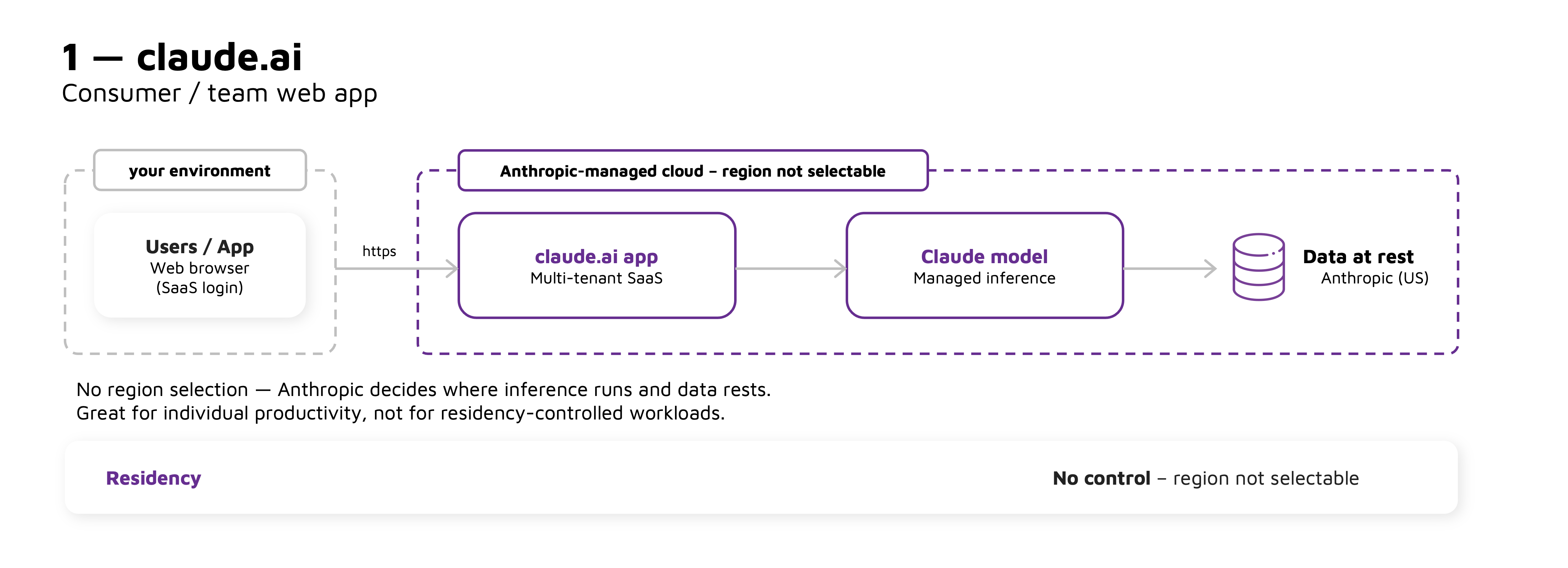
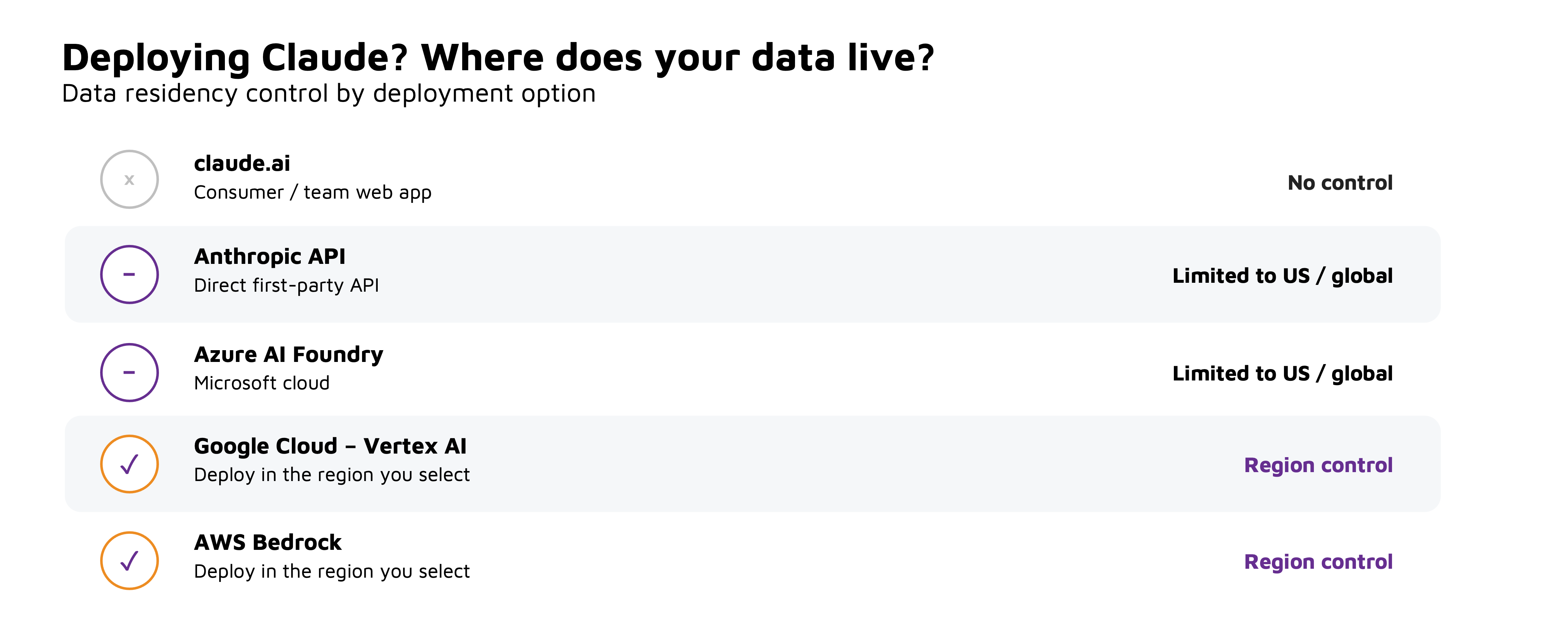
Claude.ai serves individuals, not infrastructure teams. Claude.ai is a strong productivity tool, but you cannot choose where it runs inference or stores data. For residency-driven deployments, it isn’t the right entry point.
The Anthropic API (first-party) has improved here. It now supports an inference_geo setting. This pins inference to US-based infrastructure. Workspace-level controls can enforce it.
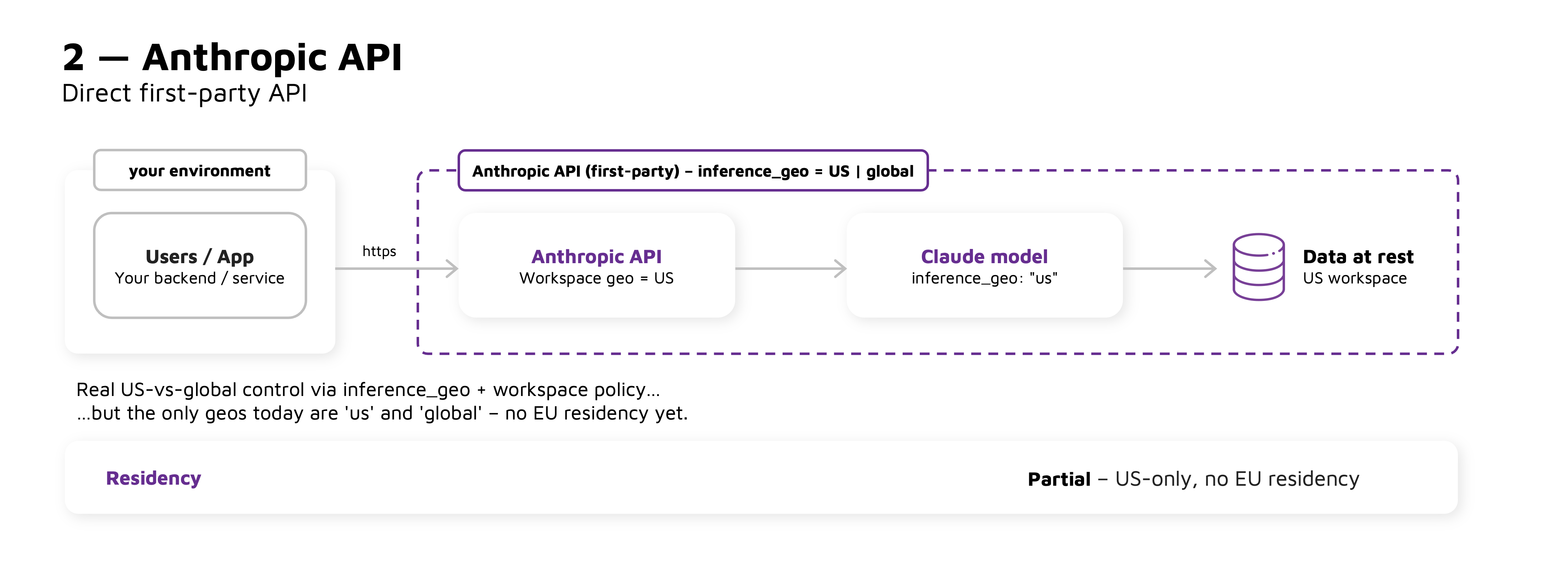
This represents real progress. However, currently we can only choose “US” or “global.” If you need Claude EU data residency, the Anthropic API does not yet fully meet that requirement.
Organizations with strict Anthropic Claude GDPR compliance requirements may need to consider alternative deployment paths. For enterprise deployments, this often means evaluating Claude on hyperscaler platforms, alongside existing cloud, data, and AI investments.
The hyperscaler paths
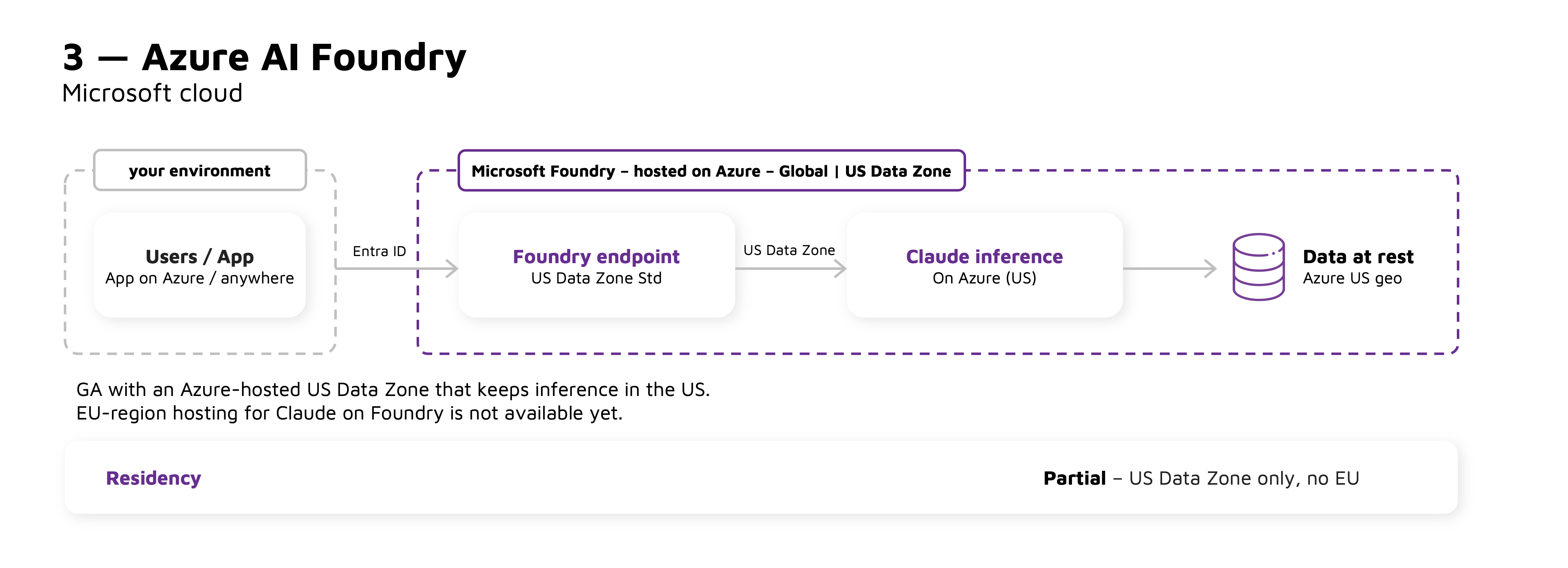
Azure AI Foundry now offers Claude with a “Hosted on Azure” deployment. This includes a US Data Zone option. This keeps inference in the United States.
This works for US-scoped workloads. However, EU-region hosting for Claude on Foundry is not yet available. That means you can’t fully meet European residency requirements.
For organizations already using Azure for analytics, data platforms, and AI initiatives, this is an important consideration when evaluating Claude deployment options.
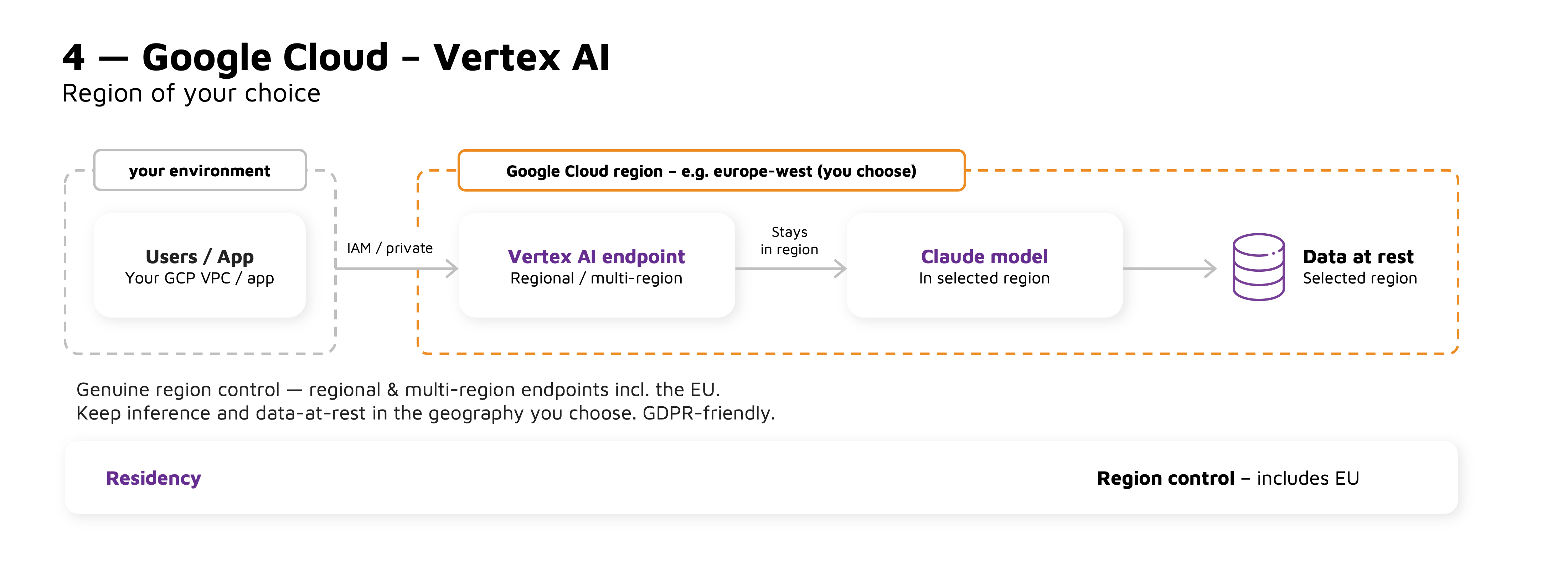
Claude on Vertex AI is where true region control starts. You can deploy to regional and multi-region endpoints, including the EU. This keeps inference and stored data within your chosen geography.
For many European organizations, this is the difference between compliant and blocked. It can also simplify internal security reviews and accelerate enterprise AI adoption. It does so by aligning deployment with regional data governance requirements.
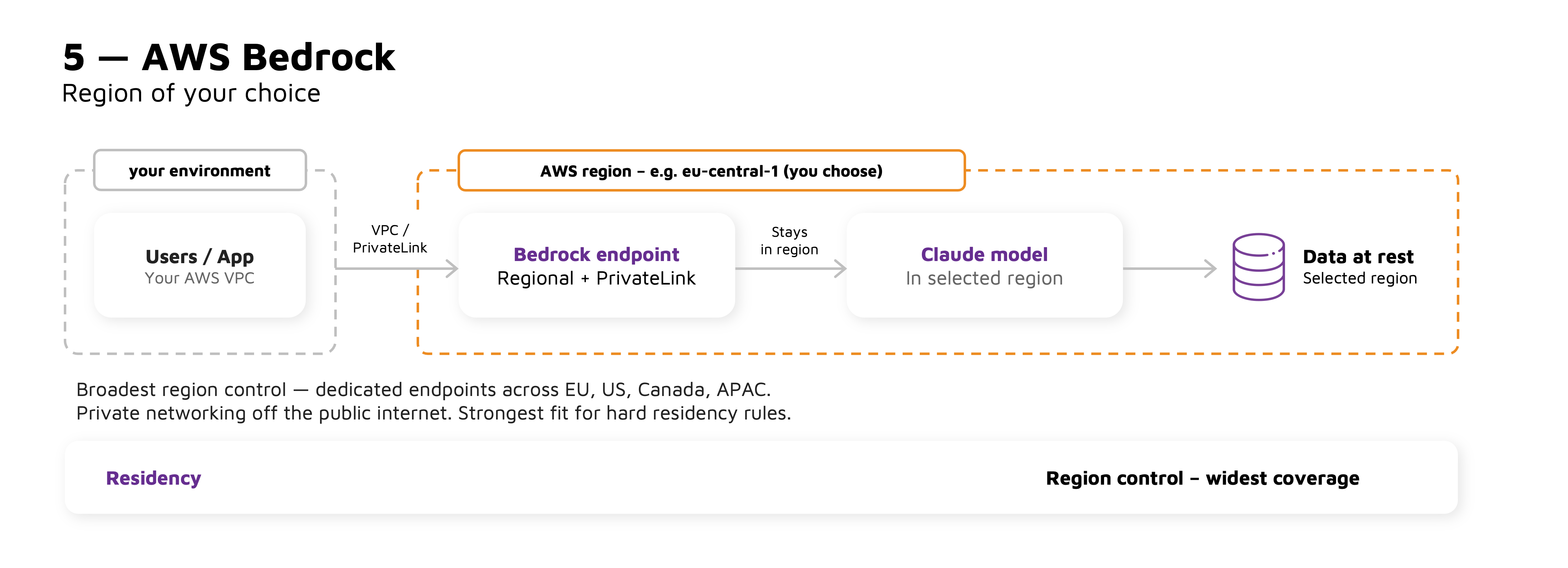
Claude on AWS Bedrock offers similar control. It has broad regional coverage. Endpoints span Europe, the US, Canada, and Asia-Pacific.
It also offers private networking. This keeps traffic off the public internet.
If data residency is a strict requirement, Bedrock currently provides the most flexibility. This makes it a strong option for enterprises that need regional hosting, private networking, and cloud-native security controls.
What this means in practice
If you must keep data in a specific region, especially the EU, Vertex AI and Bedrock are strong options. They currently lead for Claude EU data residency and regulatory compliance.
The other options have their place, but they don’t yet offer region-of-choice residency.
Choosing the right Claude deployment model
Choosing the right path, setting up the architecture, and proving compliance to your security team is rarely simple.
Organizations must balance many requirements when selecting a Claude deployment model. They must consider data residency requirements, cloud strategy, security controls, integration needs, and business objectives.
That’s where deployment expertise pays off. Working with an experienced implementation partner can help organizations accelerate adoption while reducing compliance and governance risks.
How Lingaro helps enterprises deploy Claude
As a leading data and AI services company and an Anthropic partner, Lingaro helps enterprises deploy Claude on AWS Bedrock to meet EU data residency and GDPR requirements.
We support organizations in selecting the right deployment architecture, integrating Claude into existing business and technology ecosystems, and ensuring deployments are secure, scalable, and compliant.
Lingaro also helps organizations evaluate, implement, and operate Claude Code in complex enterprise environments.
Our experts help clients:
-
Understand their security and regulatory needs
-
Choose the best deployment architecture
-
Integrate AI with existing cloud, data, and business platforms
-
Establish governance and compliance controls
Whether your organization needs EU data residency, private network deployments, Claude Code implementation, or global multi-cloud flexibility, Lingaro can help. We design and implement enterprise-ready Claude solutions that align with security, compliance, and business goals.
Note: Claude platform capabilities evolve quickly. Details above reflect Anthropic and cloud-provider documentation as of July 2026. Always verify current regional availability before committing to an architecture.
Key takeaways
-
Claude’s data residency depends on how you deploy Claude, not just on the model itself.
-
Anthropic API currently supports US-based inference controls. It does not yet offer full EU data residency options.
-
Microsoft Foundry (Azure AI Foundry) provides US data-zone deployments. It currently lacks EU-hosted Claude options.
-
Amazon Bedrock and Vertex AI offer the strongest regional deployment flexibility. This includes European regions.
-
Organizations with strict GDPR-compliant requirements should assess where inference, storage, and logging occur.
-
Choosing the right deployment architecture is essential for security, compliance, and performance.
FAQs
Is Claude GDPR compliant, and does it support EU data residency?
Claude can support GDPR-compliant deployments. Compliance depends on your deployment setup, where you process data, and your company’s controls.
Certain deployment options support EU data residency. Vertex AI and Amazon Bedrock currently offer regional deployment options that can help organizations keep data within the EU. Lingaro helps clients evaluate these options and select the deployment model that best fits their regulatory requirements.
Can I run Claude Code in my preferred cloud environment?
Yes. Enterprises can run Claude Code through cloud platforms such as Amazon Bedrock, Vertex AI, and Microsoft Foundry. Which ones they can use depends on their hosting, governance, and residency requirements. Lingaro helps organizations assess these trade-offs and design the appropriate architecture.