Most organizations invest in AI with clear expectations of efficiency, insight, and growth. Few achieve measurable returns. Issues appear when pilots stay isolated, data stays fragmented, and daily work stays unchanged.
AI Adoption begins when leaders focus on workflows and outcomes, not short term experiments, or specific tools. Lingaro's AI Adoption Playbook explains how to achieve this. It offers a practical framework focused on alignment, capability building, and steady governance to turn investment into repeatable AI ROI.
In this playbook you will learn the importance of the following AI
Data Readiness
Successful AI adoption starts with strong data readiness and avoidance of data quality issues. AI supports daily work only when the underlying data is clean, timely, and consistent. Proper data hygiene is essential. If data is unreliable, slow to update, or spread across different systems, people will not trust the results and the technology will not scale.
Leadership
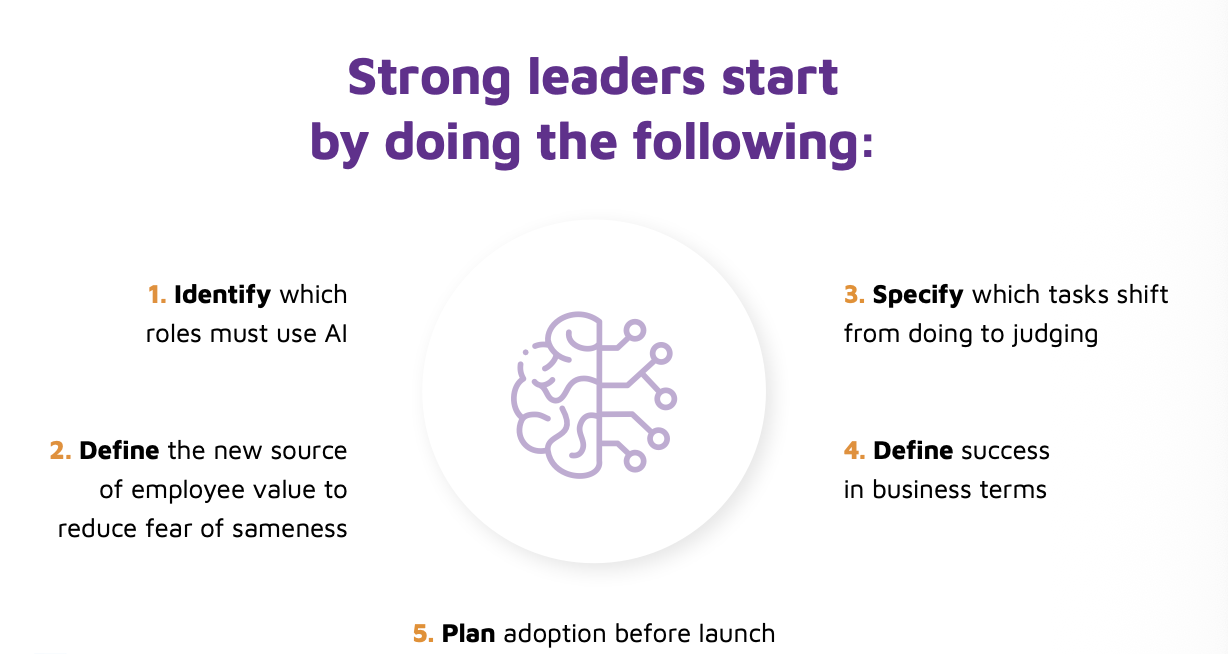
AI success depends on leadership because the technology creates value only when people use it in their daily work. While the costs of AI appear immediately through development, deployment, and maintenance, the benefits appear only when teams consistently change how they operate. Leaders must set clear business direction, integrate AI into core workflows, and model the adoption they want others to follow. Without this, organizations end up with tools that are rarely used and fail to generate meaningful value.
Adoption
AI investment keeps rising, yet measurable return remains rare. Many AI initiatives succeed in pilots but fail in daily work because poor data quality, weak ownership, and unclear workflows block real adoption. Real value appears when AI adoption connects machine learning, agentic AI, and AI solutions to strategic decisions that shape the bottom line.
Lingaro’s AI Adoption Framework
Lingaro’s AI Adoption Framework helps companies move beyond pilots by embedding AI directly into daily work. It is built on three pillars: Align, Build, and Cultivate, which work together as a continuous loop.
Align ensures leaders own the strategy and anchor AI in critical workflows. Build develops the skills, workflows, and reusable components needed for consistent execution. Cultivate strengthens trust, reinforces responsible use, and tracks real business outcomes.
Together, these pillars help organizations scale AI with clarity, confidence, and sustained value.