Pricing decisions become harder when inflation and market prices move quickly, especially when insights depend on monthly spreadsheets and quarterly elasticity estimates.
For an international beverage company operating across multiple markets, teams needed a faster, more consistent way to identify products falling behind the market, test pricing moves, and understand their effects across the portfolio.
As part of our Revenue Growth Management (RGM) offering, we brought pricing data, elasticity modeling, and scenario simulation into one platform. Commercial teams could compare potential outcomes before making pricing and portfolio decisions.
Client Profile:
The client is an international beverage company with a broad product portfolio. It needed a consistent way to assess pricing opportunities across markets, channels, categories, and products.
Challenge:
Pricing teams relied on monthly spreadsheets and quarterly elasticity estimates, making it difficult to respond quickly to changing market conditions or separate the impact of price from other demand drivers.
Inflation, shifting market prices, and growing pressure on margins increased the need for faster, more consistent pricing insights. Teams needed a reliable way to identify products falling behind the market, evaluate potential price changes, and understand substitution effects across the portfolio.
Solution:
We developed a price elasticity and scenario simulation platform as part of our Revenue Growth Management offering. It brought market, product, financial, promotional, and economic data into one environment, giving teams a consistent way to assess pricing opportunities across markets and product groups.
The platform modeled own-price and cross-price elasticities while accounting for distribution, promotions, availability, seasonality, and economic conditions. Teams could simulate pricing and other commercial changes, then compare their potential impact on volume, net sales value, profitability, and the wider portfolio.
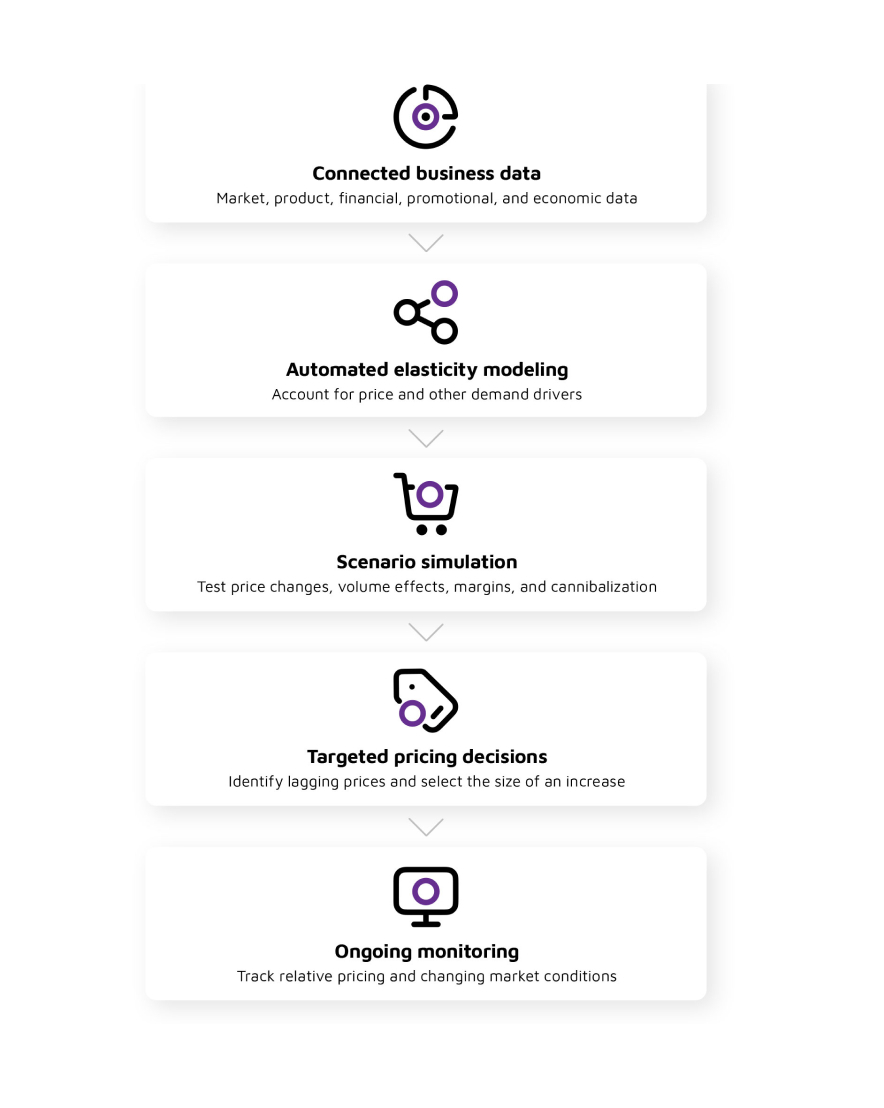
Regular monitoring helped teams identify products whose prices had fallen behind inflation and market movements. They could then simulate targeted increases and compare potential volume losses with net sales value and margin gains while accounting for cannibalization.
Azure Data Factory supported data ingestion and orchestration. Databricks, Apache Spark, and MLflow supported data preparation, modeling, and model management. Teams accessed the analysis through interactive Power BI dashboards.
Impact:
The platform established a consistent approach to pricing analysis across six markets. By automating data preparation, modeling, and scenario simulation, it reduced selected analyses from weeks to minutes, allowing teams to identify pricing opportunities without manually reviewing spreadsheets.
Pricing teams could quickly identify products falling behind market and inflation trends, simulate targeted price changes, and evaluate their expected effects on volume, net sales value, margin, and cannibalization. This enabled faster, more focused pricing decisions as market conditions changed.
The platform remains live in production, supporting regular analysis and monitoring by local and global pricing analytics teams.
Key results:
-
Weeks to minutes for selected pricing analyses
-
6 markets supported through a phased rollout
-
15+ active users across local and global pricing analytics teams
-
Data refreshed every two weeks to support regular pricing analysis
See smarter pricing decisions in action. Explore the solution with our free self-service demo. To discuss how Revenue Growth Management can support your pricing and portfolio decisions, talk to our experts.