The best revenue growth management tool depends on the commercial problem you need to solve first. This guide compares the main RGM tool categories for CPG firms and shows how to choose one based on data, integration, governance, and adoption.
Key takeaways
-
Start with the business decision, not the vendor name.
-
Reported uplift is not always growth. Look for tools that separate true demand.
-
Match the platform to your data maturity.
-
Trade spend visibility and post-event analysis are critical for CPG companies.
-
Integrated RGM platforms work best when teams need one shared model.
-
Adoption matters as much as capability.
Revenue growth management (RGM) improves profitable growth through better decisions on pricing, promotion, product mix, assortment, and trade investment. The best tools help teams turn scattered sales and promotion data into decisions they can trust. With the right tools, teams can make data-driven decisions that protect the bottom line.
Start with the business problem you need to solve
Start with the problem, not the product name. If margin leakage is the issue, start with pricing management tools. If trade spend is hard to track, prioritize trade promotion management and optimization. If teams cannot agree on the numbers, look for growth management software that connects planning, pricing, and reporting.
Modern revenue growth management solutions often cover elasticity modeling, promotion ROI simulation, trade spend analysis, scenario planning, and product mix decisions.
The right choice depends on your size and needs. A mid-market brand may need simple visibility, while a global company may need advanced analytics and deep system integration. Some tools also offer predictive analytics and dynamic pricing that adjust to market conditions.
Main types of revenue growth management tools
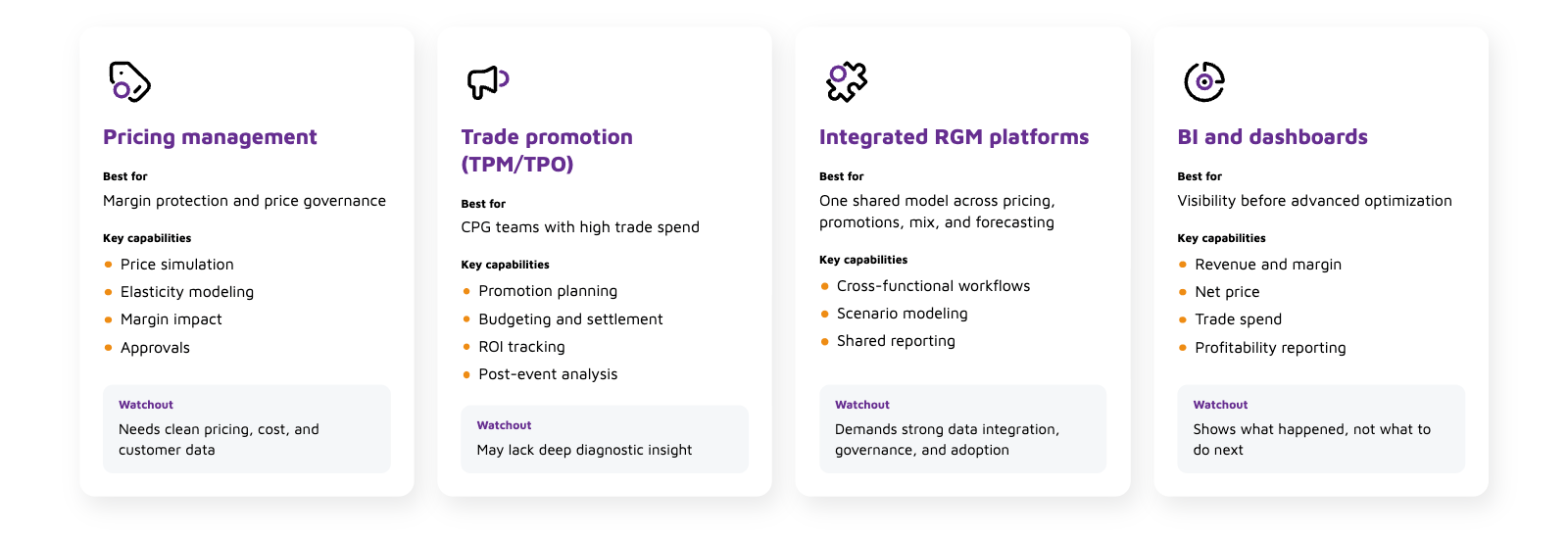
Revenue management tools can look alike in a demo, but most fit one of four categories.
Pricing management tools
Pricing management tools help teams set, test, and govern prices. In CPG, they support price changes, price-pack architecture, elasticity estimates, and retailer pass-through analysis.
Teams can test price scenarios before acting instead of relying on spreadsheets. Optimizing price helps balance sales volume, margin, and market share.
Trade promotion management and optimization
Trade promotion management (TPM) helps teams plan, budget, run, and settle promotions. Trade promotion optimization (TPO) adds analytics to predict results before money is spent.
These tools matter most when promotions take a large share of investment, and trade spend can represent 20–30% of gross sales. Yet uplift is not always growth: a +30% observed uplift may mean only +10% true demand, with the rest coming from stock-up, loyal buyers, seasonality, or cannibalization. A clear promotional plan and incrementality analysis make it easier to track promotional spending and fund the promotional activities that create value.
Integrated RGM platforms
Integrated platforms connect pricing, promotions, forecasting, assortment, and mix in one place. They suit businesses that have outgrown spreadsheets and point solutions.
The benefit is alignment: sales, finance, and planning teams work from one shared model. The tradeoff is a harder rollout. Linking plans to the demand forecast helps teams react to changes in market demand.
Business intelligence and performance management
Not every team needs an optimizer on day one. BI dashboards can show where growth comes from and where profit leaks.
They show what happened, but not why it happened, what will happen next, or what to do about it. Still, they expose hidden patterns, such as promotions that fail after trade deductions, which helps teams make more informed decisions.
Must-have features in RGM software
Good growth management software supports both analysis and workflow. Choose features that fit how your team works. Strong platforms often include:
-
Clean data connections: The tool should connect to ERP, CRM, market data, retailer feeds, and finance systems. Manual rebuilds hurt trust.
-
Scenario planning: Users should compare price, promotion, and mix scenarios before committing.
-
Elasticity and incrementality modeling: Causal models show how demand responds to price and separate true lift from stock-up, cannibalization, and seasonality.
-
Trade terms and spend visibility: The software should make rebates, discounts, deductions, and promotional funding clear, so net revenue is visible.
-
Workflow and governance: Approvals, audit trails, and permissions keep good recommendations from turning into messy execution.
-
Explainable recommendations: AI suggestions should show the drivers behind them, so teams can trust and act on them.
-
Post-event analysis: Compare expected and actual results to improve the next decision.
Vendors in the RGM market
Readers researching RGM will meet familiar vendor names. Treat these as market context, not rankings. Syndicated-data and analytics providers such as NIQ or Circana fit when external market and category data are central. CRM, ERP, and enterprise planning ecosystems such as Salesforce or SAP fit companies already using them for commercial planning.
Specialist RGM and trade promotion platforms such as Visualfabriq or CPGvision fit when teams need purpose-built promotion, pricing, and scenario tools.
Each category solves part of the problem. Syndicated data explains the market; enterprise systems run the transactions, and specialist tools optimize specific decisions. The harder part is connecting them, so pricing, promotion, and trade decisions draw on the same data and lead to a clear next step.
This is the gap Lingaro's RGM Intelligence Platform is designed to close. It combines promo optimization, trade spend optimization, and suggested pricing and promotion in one place, using causal AI to move teams from reviewing past performance to acting on recommended next steps.
Teams can achieve up to 20% higher trade-spend ROI, up to 5% margin uplift, and up to 15% more effective promotions. Lingaro starts with one high-value commercial opportunity, proves impact through a focused use case, and then scales what works.
In one example, an international beverage company used Lingaro's price elasticity and scenario simulation platform across six markets to model price changes and their impact on volume, net sales value, and profitability. Selected analyses that previously took weeks now take minutes.
How to choose the right revenue growth management tool
Pick the platform that fits your decisions, data maturity, and capacity for change. A powerful tool adds no value if teams do not trust or use it.
Use this buying checklist before committing:
-
Define the primary use case. Pricing, promotional ROI, trade terms, mix, forecasting, or visibility?
-
Map the decision owners. Sales, finance, category management, demand planning, or leadership?
-
Audit data readiness. Check product, customer, pricing, promotion, and sales history.
-
Test real scenarios. Ask vendors to model a current decision, not a demo.
-
Check integration needs. Confirm links to ERP, CRM, finance, and data providers.
-
Evaluate explainability. Users should understand why a recommendation appears.
-
Plan for change management. Training and governance drive adoption.
-
Avoid overbuying. Start with reporting if visibility is the main gap.
This keeps the focus on outcomes, not on software for an ideal future process.
Final thoughts: Pick a tool your team will adopt
Revenue growth management is more than software. When pricing, promotions, and trade terms become too complex for spreadsheets, CPG firms need tools backed by trusted data, connected workflows, and clear governance.
Start with the decision that matters most, shortlist the right tool category, and test platforms with your own data. Not sure where to begin? The RGM Maturity Roadmap for CPG Leaders shows where your RGM stands, which capabilities to prioritize, and how to start a 90-day plan. Lingaro can then help assess data readiness, integrate systems, build analytics, and support adoption so teams make more consistent commercial decisions.
To see Lingaro's RGM Intelligence Platform in practice, try the 3-minute, interactive, self-guided demo.
FAQs
What is a revenue growth management tool?
An RGM tool is software that helps companies grow profitably through better decisions on pricing, promotions, product mix, assortment, and trade investment.
What is the difference between TPM and TPO?
TPM helps teams plan, budget, execute, and settle trade promotions. TPO adds predictive analytics to simulate outcomes before funds are committed.
Does every CPG company need an integrated RGM platform?
No. Many teams start with dashboards and structured planning, then move to advanced optimization once data and processes are ready.
What data does an RGM tool need?
Reliable product, customer, pricing, promotion, cost, deduction, and sales history, ideally connected from ERP, CRM, and market data sources.
How can you measure whether an RGM tool is working?
Track net revenue, margin, and trade spend ROI, and use post-event analysis to compare expected results with actual performance.
Can I see how the RGM Intelligence Platform works in practice?
Yes. The self-guided demo takes three minutes and shows how teams identify which promotions drive incremental value and where the budget can work harder.