For CPG RGM leaders, evaluating promotions is getting harder. Sales may rise during a promotion, but that does not mean it created profitable new demand. The uplift may simply reflect shoppers' stocking up, loyal customers buying earlier, sales shifting from another SKU, or purchases that would have happened anyway.
Key benefits
-
Promotion uplift does not always mean incremental growth.
-
CPG teams need to separate real demand from non-incremental drivers.
-
Better RGM decisions can deliver up to 5% margin uplift and 10% lower value leakage.
For busy CPG leaders, the problem is not a lack of data. It is turning that data into clear guidance for better decisions. Teams must justify trade budgets, explain promotion results, protect margins, and respond to retailer pressure, often with fragmented data and little time to plan.
That clarity helps leaders drive sales, protect profit margins, and connect promotion plans to wider business goals.
Dashboards, pricing files, market reports, and post-event reviews show what happened. But they rarely show which sales came directly from the promotion, which spend went toward sales that would have happened anyway, or what teams should do differently next time.
It also shows how data sources, real-time data, and supply chains affect what teams can act on. That is why RGM is shifting from analyzing what happened to helping teams decide what to do next, connecting insights, scenarios, recommendations, approvals, actions, and measurable results.
The uplift in your dashboard may be overstating growth
A promotion may show strong uplift, but that uplift can mix true incremental demand with stock-up, pull-forward purchases, loyal-buyer spend, cannibalization, seasonality, and other effects.
That matters because trade spend can represent 20% to 30% of gross sales. Optimized promotion programs can become up to 15% more effective, while better trade-spend prioritization can reduce waste by up to 20%.
The goal is not to promote less. It is to identify where each euro of trade spend creates measurable demand, margin, and retailer value and where it doesn’t
The same view helps CPG brands understand price sensitivity, customer loyalty, and the role of retail partners.
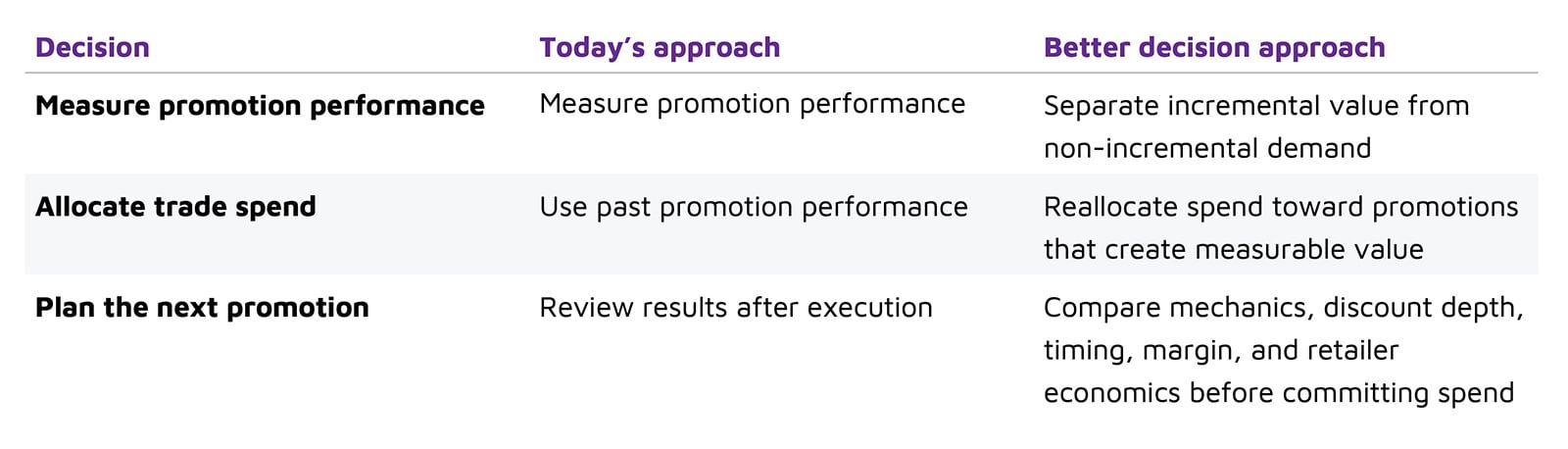
Today’s vs. better decision approach
4 actions to improve your next promotion decision
-
Separate real growth from uplift.
Identify how much of the result was genuinely incremental rather than driven by stock-up, loyalty, cannibalization, or other effects.
-
Identify what created value.
Determine which promotion mechanics actually contributed to demand, margin, and ROI.
-
Compare the next options before committing spend.
Test discount depth, timing, mechanics, margin guardrails, and retailer economics.
-
Fund what works.
Scale promotions that generate incremental value and redesign or reallocate spend from those that do not.
From scenarios to better decisions
Once teams understand the cause, they can compare options before committing spend, including promotion mechanics, discount depth, timing, price moves, margin guardrails, retailer economics, and trade-spend allocation.
The best option is not always the one with the highest short-term volume. It is the option that protects margin, creates incremental demand, supports the retailer story, and improves cost per incremental unit.
That creates a stronger retailer conversation: not “we are cutting promotions,” but “we are shifting investment toward the mechanics that grow the category and improve economics for both sides.”
Agentic AI turns insight into action
The use of specialized AI advisors, such as Lingaro’s RGM Platform Intelligence, can analyze promotion and trade-spend signals, which can turn them into prioritized recommendations. Teams can review, challenge, and approve those recommendations before acting. Always with a human in the loop.
Continuous monitoring can support up to 2× faster opportunity identification, while human teams remain in control of commercial decisions.
What better RGM decisions create
Better RGM decisions translate insight into measurable commercial outcomes:
Scale promotions that generate incremental value and redesign those that do not.
Reduce wasted trade spend and protect margin.
Prioritize opportunities faster with less manual analysis.
Connect pricing and promotion decisions more clearly to P&L impact.
That gives decision makers a clearer way to manage promotion spending, promotional activity, slotting fees, and the cost of goods sold behind each choice.
It also links products and services, customer base, marketing strategy, and the bottom line in one decision loop for CPG companies.
With sufficient data and adoption, these improvements can translate into measurable margin and efficiency gains (5% margin uplift and up to 10% lower value leakage).
Why Lingaro
Lingaro’s RGM Platform Intelligence brings causal modeling, AI advisors, simulation, orchestration, and business guardrails into one connected approach for CPG teams. It helps turn complex commercial signals into clear, evidence-based decisions on pricing, promotions, trade spend, and margin.
Ready to make CPG trade spend decisions faster and more defensible?
See how Lingaro helps RGM teams focus on investment where it creates measurable value.
FAQ
How does decision intelligence improve a pricing strategy?
It uses evidence, simulation, and business guardrails to make pricing decisions more consistent and confident.
Can it help after a price increase?
Yes, it helps explain the performance change and whether the result came from price, market demand, or other factors.
How does it support trade spend ROI?
It shows which promotions create real demand and which spend should be reallocated.
How do commercial teams use recommendations?
They review the recommendation, apply judgment, and move from approval to action.