Retail price reductions help large retail chains defend market share, clear inventory, increase traffic, and respond to competitors. But frequent or poorly targeted discounting can reduce gross margin, train shoppers to wait for deals, and shift demand away from full-price purchases. The most profitable retailers treat discounts as precision tools. They use data-driven pricing, promotion analytics, and scenario planning to understand when a discount creates incremental value and when it only moves revenue forward while eroding margin.
Key summary
-
Retail price reductions can increase volume, but they only improve profitability when incremental sales outweigh margin loss.
-
Discount impact on profitability depends on price elasticity, shopper behavior, inventory position, competition, and product mix.
-
Retail margin erosion accelerates when promotions are too broad, too frequent, or disconnected from category economics.
-
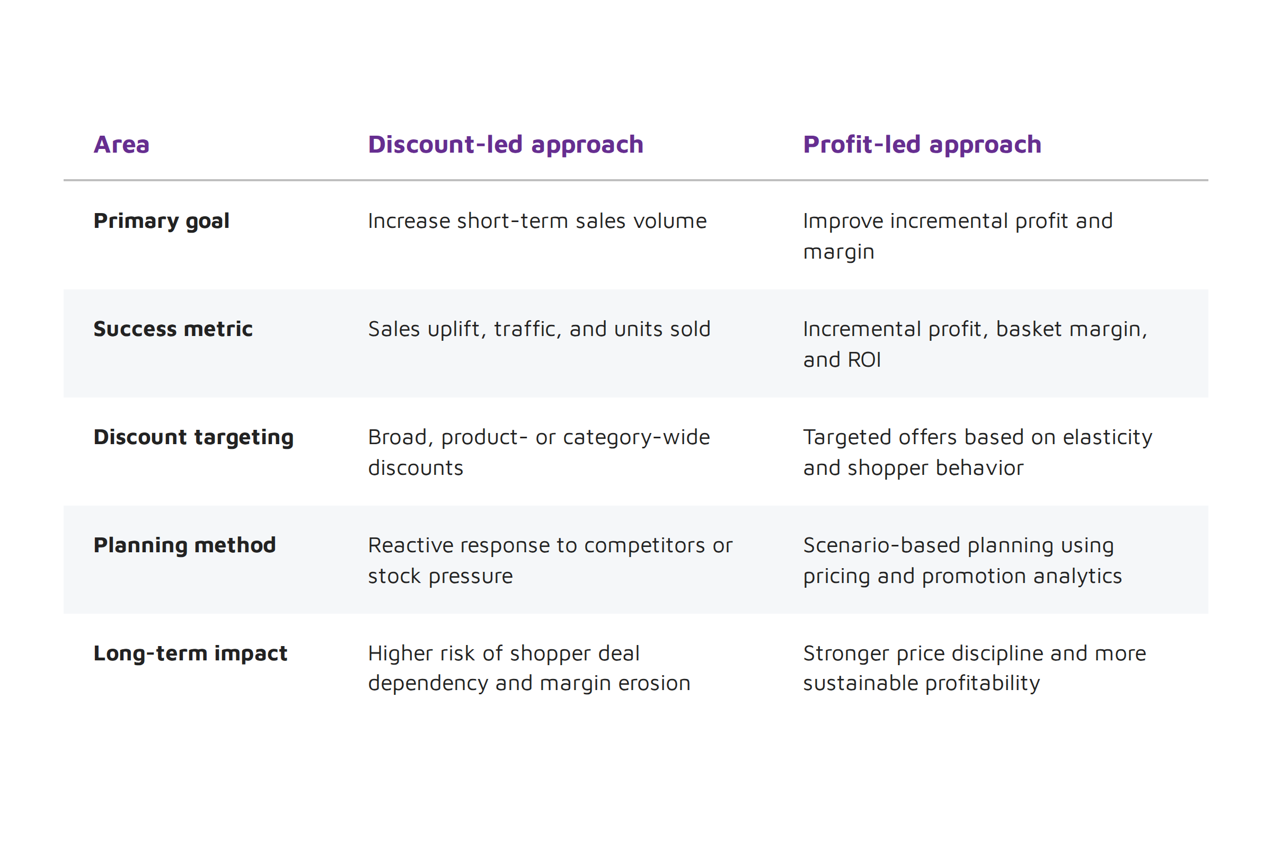
Promotion effectiveness should be measured by incremental profit, not just sales uplift, traffic, or units sold.
-
A disciplined price discounting strategy uses analytics, scenario planning, and governance to protect margins while staying competitive.
Why retail price reductions are so tempting
For large retail chains, price reductions are one of the fastest ways to influence shopper behavior. A lower price can increase visits, protect category share, move seasonal stock, support supplier-funded campaigns, and create a visible response to competitors.
But the harder question is whether the extra demand is profitable. A promotion that lifts volume can still weaken profit if reduced unit margin, cannibalized sales, and execution costs outweigh the benefit. This is why retail price reductions need a profitability lens, not a sales-only lens.
How discounts affect profitability
Discounts affect profitability in connected ways. First, they reduce gross margin immediately. If a product sells for $10 with a $3 gross margin, a $1 discount removes one-third of the gross profit per unit. The retailer then needs enough incremental volume to recover that loss.
Second, discounts can shift demand. A promotion may pull future purchases into the current period, creating a short-term sales spike followed by a weaker baseline. It can also move shoppers from full-price products to promoted products, worsening the discount impact on profitability.
Third, promotions add operational cost across store labor, inventory planning, replenishment, supplier coordination, merchandising, pricing systems, and customer service. If supply cannot match demand, the promotion can damage both profit and customer experience.
The hidden risk of retail margin erosion
Retail margin erosion rarely comes from one discount event. It builds as teams repeat the same mechanics, extend deals too broadly, or react to every competitor move without a clear profitability threshold. Over time, shoppers learn the discount rhythm and become less willing to pay full price.
At scale, even small margin changes matter. A few basis points of margin loss across thousands of SKUs, stores, and transactions can outweigh the visible revenue gains from a campaign.
Why promotion effectiveness needs better measurement
Promotion effectiveness is often measured by sales uplift, but uplift alone can mislead. A better view considers incremental volume, baseline demand, basket margin, cannibalization, stock availability, supplier funding, competitor response, and customer lifetime behavior.
Large retailers also need to evaluate promotions by SKU, category, region, and channel. A campaign may work in one area and fail in another, so teams need connected data across point of sale, inventory, trade terms, shopper behavior, and finance.
AI and advanced analytics make this measurement more practical by evaluating many pricing and promotion scenarios, recommending optimal mixes, and creating a feedback loop across pricing, promotions, trade, assortment, and channel planning.
Discount-led vs. profit-led pricing
 Building a smarter price discounting strategy
A smarter price discounting strategy starts with knowing the job of each discount. Some protect traffic, some clear stock, and others support loyalty, supplier-funded activity, or category growth. Each objective needs a different success metric.
The next step is segmentation. Retailers should avoid treating every store, channel, product, and customer group the same. Price elasticity, basket behavior, inventory position, and local competitive intensity should guide where discounts are used.
Finally, retailers need governance. Pricing, category, finance, supply chain, and store operations teams should work from the same assumptions. Scenario planning helps test discount depth, timing, duration, and eligible products before execution.
Where AI changes retail pricing decisions
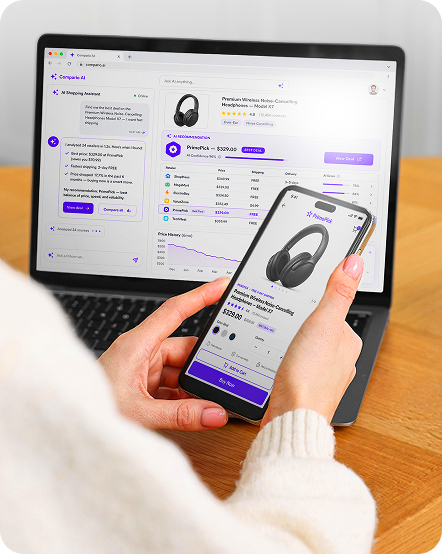
AI helps retailers move from reactive discounting to evidence-based pricing. Machine learning models can estimate price elasticity, predict demand response, identify cannibalization, and recommend scenarios that balance revenue, margin, and inventory goals.
AI is especially useful when pricing decisions involve seasonality, competitor prices, supplier terms, product availability, basket composition, shopper sensitivity, and channel mix. It helps teams compare options faster and see trade-offs before prices reach the shelf or digital storefront.
In one Lingaro retail dynamic pricing project, a semi-automated pipeline generated weekly price suggestions for selected SKUs and stores using demand modeling, causal methods, and margin optimization. The pilot showed stronger margin impact in test stores than in control stores.
How Lingaro can help
Lingaro helps retail and CPG organizations improve pricing, promotion, and revenue growth decisions by connecting data foundations, commercial analytics, AI, and user adoption. Its Revenue Growth Management capabilities cover price management, promo management, assortment optimization, trade spend and profitability analysis, price elasticity analytics, what-if scenarios, promo effectiveness, and profit optimization.
For retailers and CPG companies facing margin pressure, fragmented data, and frequent discount decisions, Lingaro can support the full journey: assessing data readiness, integrating POS and commercial data, building price elasticity models, developing promotion effectiveness dashboards, designing scenario simulators, and embedding recommendations into trusted workflows.
Because Lingaro combines domain knowledge, data engineering, data science, visualization, and adoption expertise, the goal is not another dashboard. It is better decision-making that protects profitability while responding to market conditions.
FAQs
How do price reductions affect retail profitability?
They can increase sales volume, but profitability improves only when incremental profit exceeds margin loss.
Why can discounts hurt margins?
Discounts reduce unit profit and can shift demand away from full-price purchases.
What makes a promotion effective?
An effective promotion creates incremental profit, not just higher sales or traffic.
How can retailers avoid margin erosion?
They should use targeted discounts, clear profitability thresholds, and post-campaign analysis.
How can AI improve pricing decisions?
AI helps retailers model elasticity, predict demand, and compare discount scenarios faster.